
“Should I workout when sore?” is one of the most common questions we get from people mid-training block, and the honest answer is that it depends on what kind of sore you are. This quick self-check asks seven simple questions and gives you one clear recommendation: train as planned, train lighter, or rest and consider getting it assessed.
You get your answer instantly on this page. Nothing you enter is stored or sent anywhere, there is no sign-up, and it is not a diagnosis.
Please note: this tool gives general educational information only. It does not diagnose, it is not a replacement for a professional assessment, and it cannot guarantee accuracy for any individual case.
Red flags: get urgent help, not an online tool
Go to A&E or call 999 straight away if you have any of these:
- Sudden, severe pain, or a visible deformity of a bone or joint
- You cannot put any weight through the injured leg at all
- Numbness, tingling or loss of feeling, or a limb that looks pale or cold
- Signs of infection: heat, spreading redness, fever or feeling generally unwell
- Chest pain, or shortness of breath
- Any head injury followed by confusion, repeated vomiting or loss of consciousness
For anything that worries you but feels less urgent, NHS 111 is available any time.
Sore or injured? Answer seven quick questions
Worked Example: Day 2 Leg Soreness After A Heavy Squat Session
- Answers
- 2 days since the session. Soreness in the muscles of both legs evenly. Dull and achy. Stiff and sore but moving normally. Getting better. No swelling. No red flags.
- Recommendation
- Train as planned
Why: the soreness is in the muscles on both sides, which is typical of DOMS; it feels dull and achy; it is improving day to day; there is no swelling or bruising.
This looks like normal delayed onset muscle soreness, and light movement will likely help it settle. Warm up a little longer than usual and ease into the first few sets if today’s session hits the same muscles. If the same answers had included sharp pain, one-sided joint pain, swelling or soreness that was getting worse, the result would have been “rest it and consider an assessment” instead.
DOMS Versus An Actual Problem, What’s The Real Difference
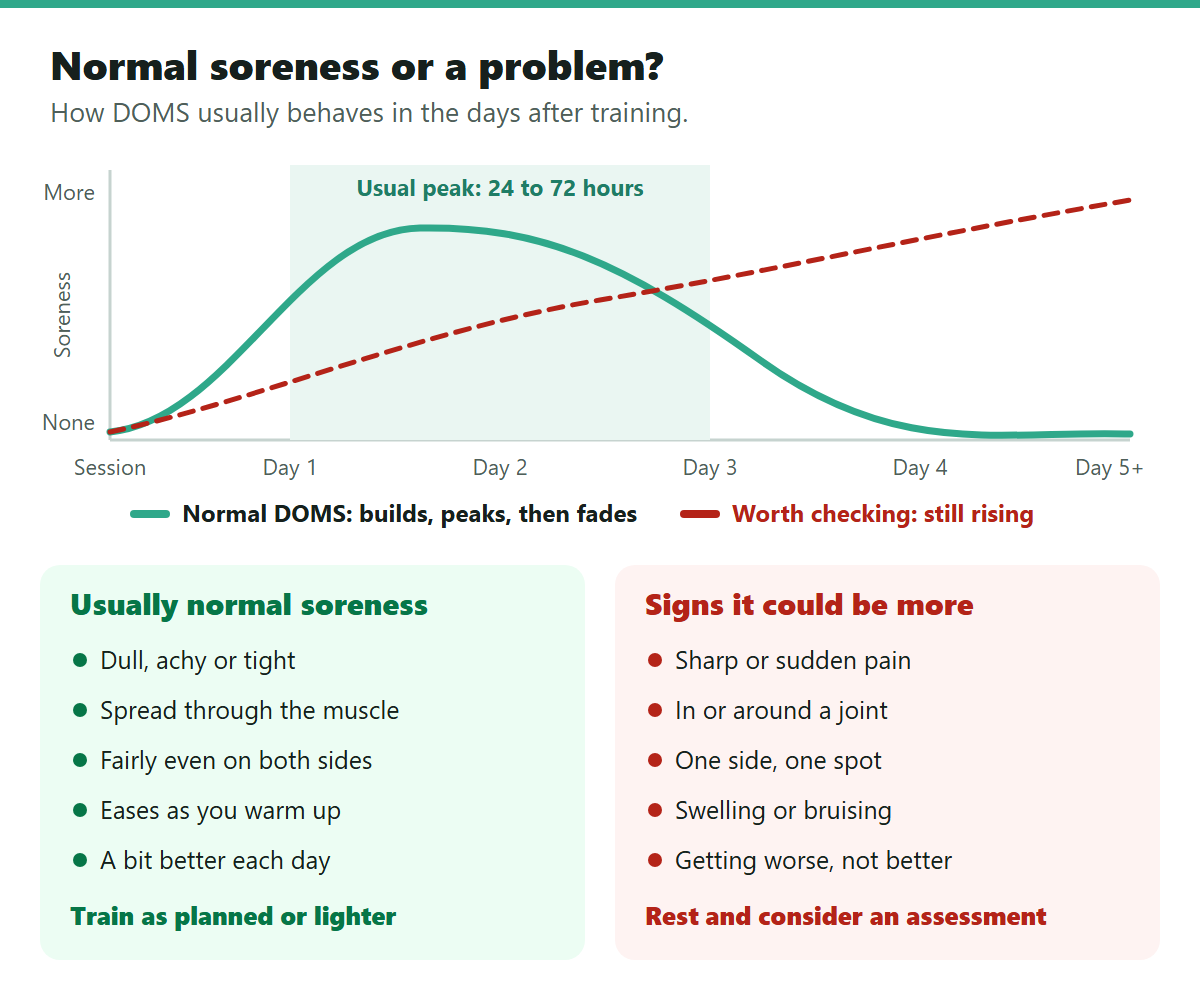
Delayed onset muscle soreness, or DOMS, is the stiff, achy feeling that turns up a day or two after a session that was harder, longer or simply different from what your body is used to. It usually peaks somewhere between 24 and 72 hours, then fades over the next few days. It is a normal response to new or heavy loading, especially lowering movements like the down phase of a squat or running downhill.
DOMS has a recognisable feel. It is spread through the muscle rather than pinpointed in one spot, it tends to be fairly even on both sides if you trained both sides, it feels dull, tight or achy rather than sharp, and it eases as you warm up and move. Crucially, it gets a little better each day.
An injury tends to behave differently, and those differences are exactly what the self-check looks for. Sharp or stabbing pain, especially if you felt it at a specific moment during the session, is a different category. So is pain that sits in or around a joint or tendon, pain on one side only that does not match what you trained, swelling or bruising, and anything that is getting worse rather than better. Any one of those is enough for the tool to suggest resting and considering an assessment, regardless of your other answers.
There is one rare but important exception worth knowing about. After an extremely hard or unfamiliar session, severe pain and swelling with very dark, cola-coloured urine can be a sign of rhabdomyolysis, a serious breakdown of muscle tissue that needs urgent medical attention. It is uncommon, but it is why the self-check asks.
Why Active Recovery Often Beats Total Rest For Normal Soreness
Most generic advice gives you one of two blanket answers: “rest until you’re not sore” or “just push through it”. Neither is great. If you rested every time you had DOMS, you would barely train during a new block, and pushing through hard on very sore muscles usually just means a worse session with more fatigue.
For genuine DOMS, the middle ground tends to work best. Light movement increases blood flow to the sore muscles, reduces stiffness and, in our experience, makes most people feel noticeably better within the session. Research suggests the effect on soreness is temporary, but feeling looser and moving well is worth having, and keeping your routine going matters for long-term progress.
Active recovery can be as simple as a 20 to 30 minute walk, an easy bike or swim, a mobility session, or training a different muscle group. If you do train the sore muscles, many people find a lighter version works well: fewer sets, slightly less weight, and a longer warm-up. You will probably feel a little weaker or slower than usual while you are sore, and that is completely normal. Expect it rather than chasing personal bests.
The exception is soreness that is severe enough to change how you move. If walking downstairs is a struggle, your body is telling you that today is a light day. Training hard with altered movement is where people start to compensate, and compensation is a common route into a genuine injury.
When Soreness Is Actually Hiding An Injury
Sometimes what feels like soreness is a mild strain or the early stage of an overuse problem, such as a tendon that is starting to complain about a jump in training load. These usually give themselves away by not following the normal DOMS pattern: they linger, sit in one spot, or flare every time you load them.
At Impact Sports Rehabilitation we tell the difference in person by asking how it started and how it has behaved, then examining the area. We check where it is tender, how it responds to specific movements and resisted tests, and compare strength and range with the other side. That usually makes it clear whether you are dealing with ordinary soreness, a minor strain, or something that needs a structured plan.
If it is a training-load issue, a rehabilitation consultation can set out how to adjust your programme without losing fitness. If it is tight, overworked muscle, sports massage is one of the ways we help it settle so you can keep training comfortably. We work with runners, gym-goers, footballers and combat-sports athletes from our clinic in Eccles, and online.
Not sure whether it is soreness or something more? Book in with Impact Sports Rehabilitation in Eccles, or online, and get a clear answer before it costs you training time.
Frequently Asked Questions
Is it bad to work out when you’re sore?
Usually not, if it is normal muscle soreness. Light to moderate training is generally fine with DOMS and can help you feel looser. What is worth avoiding is training hard through sharp pain, joint pain, swelling or soreness that is getting worse, because those are signs it might not be DOMS.
I’m still sore after 2 days. Should I work out?
Day two is often when DOMS peaks, so being sore then is very normal. If the soreness is dull, in the muscles, fairly even on both sides and starting to ease, many people do fine with their planned session or a slightly lighter version. If it is very severe or affecting how you move, go for active recovery instead.
Does being sore mean I had a good workout?
Not necessarily. Soreness mostly reflects how new or unfamiliar a session was, not how effective it was. As your body adapts, you will often get less sore from the same training while still making progress, so do not chase soreness as a sign of a good session.
Can I train a different muscle group while sore?
Yes, and it is a sensible option. Training upper body while your legs recover, or the other way round, keeps your routine going without loading the sorest muscles hard. Light cardio and mobility work are good choices too.
How do I know if it’s an injury and not just soreness?
Watch for pain that is sharp, sits in one spot or around a joint, is on one side only, comes with swelling or bruising, or is getting worse rather than better. Normal soreness feels dull and spread out and eases a little each day. If you are unsure, getting it assessed is the quickest way to find out.
Can Impact Sports Rehabilitation help if soreness keeps coming back?
Yes. Soreness that keeps returning in the same spot, or never quite clears, often points to a training-load or recovery issue, or an early overuse injury. Impact Sports Rehabilitation can assess what is going on and help you adjust your programme, with sports massage and rehab where it helps.
This self-check from Impact Sports Rehabilitation is for general educational purposes only. It does not diagnose any condition, it cannot guarantee that any training decision will prevent injury, and it is not a substitute for professional medical diagnosis or treatment. If you have sharp, localised or worsening pain, please seek a professional assessment, and for any red flag symptoms go to A&E or call 999.