Our injury recovery time estimator gives you a realistic, honest range for how long common sports injuries usually take to recover, based on typical physiotherapy timelines. Pick the injury you have, or have been told you have, add the severity if you know it, and you will get both a recovery range and RICE guidance for that specific injury on the same screen.
Your result appears instantly on this page. Nothing you select is stored, logged or sent anywhere, there is no sign-up, and it is not a diagnosis.
Please note: this tool gives general educational information only. It does not diagnose, it is not a replacement for a professional assessment, and it cannot guarantee accuracy for any individual case.
Red flags: get urgent help, not an online tool
Go to A&E or call 999 straight away if you have any of these:
- Sudden, severe pain, or a visible deformity of a bone or joint
- You cannot put any weight through the injured leg at all
- Numbness, tingling or loss of feeling, or a limb that looks pale or cold
- Signs of infection: heat, spreading redness, fever or feeling generally unwell
- Chest pain, or shortness of breath
- Any head injury followed by confusion, repeated vomiting or loss of consciousness
For anything that worries you but feels less urgent, NHS 111 is available any time.
Estimate your recovery time
Worked Example: A Moderate Calf Strain
- Injury selected
- Calf strain
- Severity
- Moderate (a limp, and pain going up on your toes)
- Typical recovery
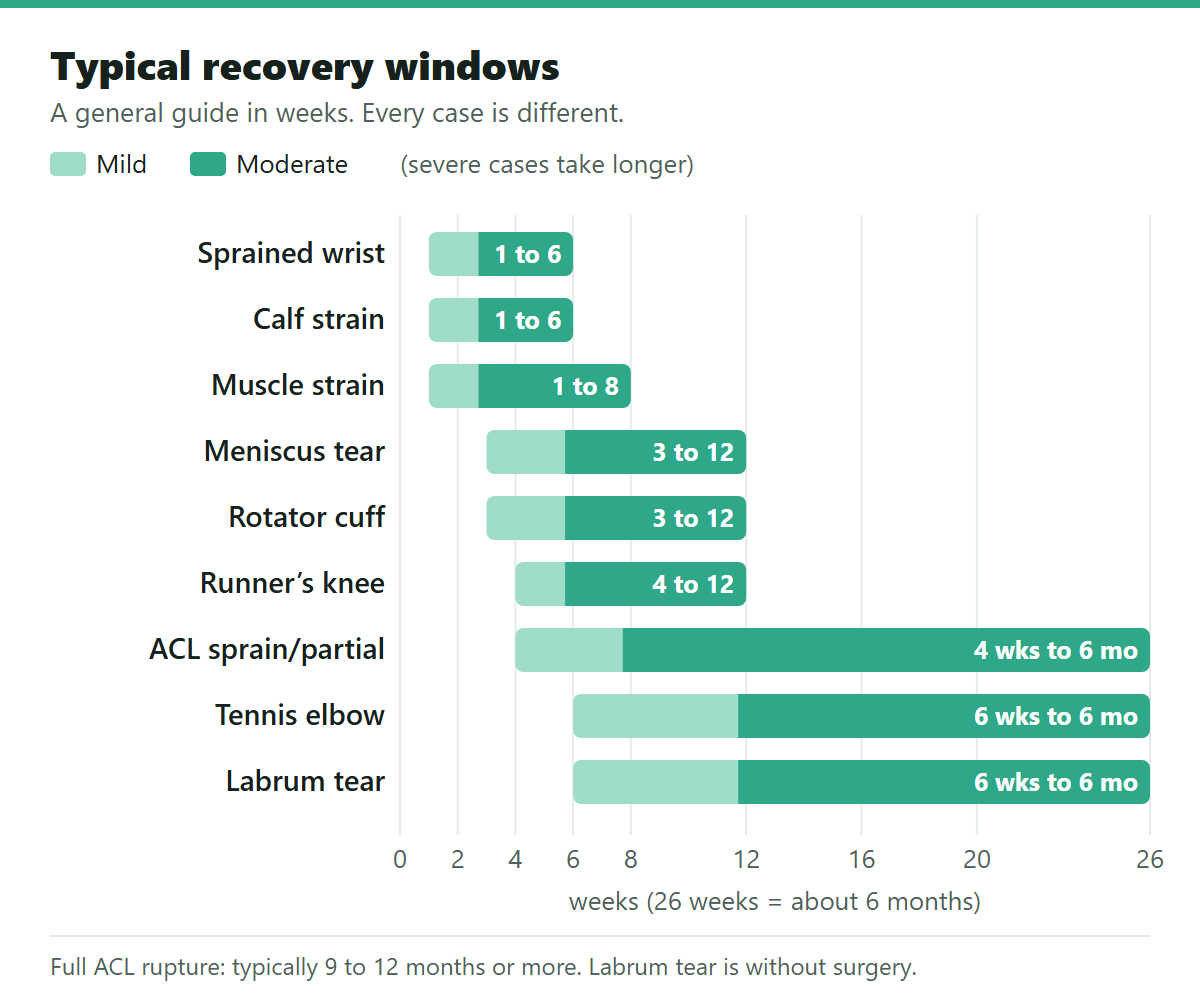
- 3 to 6 weeks, as a general guide
RICE for a calf strain, first 48 to 72 hours:
- Rest: rest from running, jumping and hills, but keep walking short distances if it is comfortable.
- Ice: 15 to 20 minutes wrapped in a cloth, several times a day for the first 48 to 72 hours.
- Compression: a calf sleeve or elastic bandage from ankle to below the knee.
- Elevation: foot up above hip height on cushions when you are resting.
Many people find a mild calf strain settles in 1 to 3 weeks, while a moderate one more often takes 3 to 6. The usual setback is going back to running before you can do pain-free single-leg calf raises. If it felt like being kicked in the back of the ankle, the Achilles tendon needs checking in person that day.
Why Recovery Time Ranges Vary So Much Between People
If you have ever compared notes with a teammate who had “the same injury” and was back in half the time, you will know how frustrating this can be. The honest truth is that a diagnosis like “hamstring strain” covers a huge spread of damage, from a few irritated fibres to a significant tear, and that is the single biggest reason two people’s timelines look so different.
Severity is the starting point. A mild strain where you still have most of your strength is a very different job for your body than a tear that leaves you limping, which is why the estimator asks for it. If nobody has graded your injury, the “Not sure” option gives a wider range that covers the most common cases.
Age and general health come next. Tissue repair tends to slow down a little as we get older, and sleep, stress, smoking and overall fitness all play a part. None of that means an older athlete cannot recover well, it just means the middle or upper end of a range is often more realistic than the quickest figure you read online.
Training history matters too. Someone who has been strength training for years usually has more resilient tissue and better body awareness than someone who has just started running. A previous injury in the same spot can work the other way, because scar tissue and lingering weakness make it easier to re-injure.
Finally, and this is the one you have the most control over, timelines depend heavily on how early proper rehab starts and how consistently you stick with it. In our experience, two people with an identical calf strain can end up weeks apart purely because one did their exercises most days and the other rested and hoped.
What Actually Speeds Up Recovery (And What Slows It Down)
The first few days after an injury are about protecting it and settling things down, which is where RICE (rest, ice, compression and elevation) still has a sensible place. The key word is relative rest. Stopping the activity that hurt it is wise, but staying completely still for a week usually is not. Research suggests that early, gentle movement within comfort helps healing tissue line up and strengthen properly, and it stops the surrounding muscles from wasting away.
After those first few days, most injuries respond best to gradually increasing load. That might be walking, then calf raises, then jogging for a calf strain, or simple range-of-movement work, then strengthening, for a shoulder. Healing tissue adapts to the demands you put on it, so a well-paced plan builds it back stronger, not just healed.
Sleep and nutrition are not glamorous, but they are a real part of tissue repair, and many people find recovery feels slower when they are run down. Supportive treatments can also help you move and load more comfortably while you heal. Sports massage, cupping, acupuncture and Rocktape taping are all things we use alongside rehab, not instead of it.
The things that slow recovery down are usually predictable. Resting for too long, then going straight back to full training, is the classic one. So is pushing through sharp pain to test it, skipping the boring strength work once the pain fades, and ignoring swelling that keeps coming back. If your injury is not improving week on week, that is a signal to get it looked at rather than waiting it out.
When An Estimate Isn’t Enough And You Need A Proper Assessment
A tool like this is a useful starting point, but it can only work with the injury type you give it. It cannot test your strength, check whether a ligament is stable, or spot that your “pulled muscle” is actually something else. That is what a proper assessment is for.
At a rehabilitation consultation with Impact Sports Rehabilitation, we start by finding out exactly what happened and what you are training for, then examine the area properly. From there we can tell you where you are likely to sit within (or outside) these ranges, and build a step-by-step plan with clear milestones, so you know what to do this week and what “ready” will look like. If something needs a scan or a medical opinion, we will tell you that too.
We see clients in Eccles, close to Salford, Trafford and the rest of Manchester, and we offer online consultations if you are further afield.
Want to swap a general estimate for a plan built around your injury, your sport and your goals? Book a rehabilitation consultation with Impact Sports Rehabilitation in Eccles, or online if you are further away.
Frequently Asked Questions
How accurate is an injury recovery time estimator?
It is a useful general guide rather than a precise prediction. The ranges come from typical physiotherapy timelines for each injury and severity, so they describe what many people experience. Your own recovery could be quicker or slower depending on the exact damage, your age, your training history and how consistently you do your rehab.
How long does a pulled muscle take to heal?
As a general guide, a mild pulled muscle often settles in 1 to 3 weeks, a moderate strain more typically takes 3 to 8 weeks, and a severe tear can take 3 months or longer. Starting gentle movement and strengthening after the first few days, rather than resting until it feels perfect, tends to help.
Should I still use RICE, or is that outdated now?
RICE still has a place in the first 48 to 72 hours, mainly for managing pain and swelling. What has changed is the “rest” part. Research suggests relative rest and early, gentle movement usually work better than complete rest, so think of RICE as a short first step before a gradual return to loading, not the whole plan.
I don’t know how bad my injury is. Can I still use this?
Yes. Choose “Not sure” and the estimator gives a wider range that covers the most common severities for that injury. If you want a more specific answer, a professional assessment can grade the injury properly and tell you where you are likely to sit within that range.
Why is my recovery taking longer than the estimate?
It happens more often than people think. Common reasons include an injury that is more severe than it first seemed, returning to training too early, skipping strength work, or a different problem entirely. If you are not improving week on week, it is worth getting it assessed rather than waiting.
Can Impact Sports Rehabilitation give me a more exact timeline?
We can give you a far more specific one. At a rehabilitation consultation, Impact Sports Rehabilitation assesses the injury in person (or online), grades it, and builds a milestone-based plan around your sport. No one can promise an exact date, but a proper assessment usually narrows the range a lot and tells you exactly what to work on.
This injury recovery time estimator from Impact Sports Rehabilitation is for general educational purposes only. It does not diagnose any condition and is not a substitute for professional medical diagnosis, advice or treatment. Recovery ranges are typical general guidance, not guaranteed timelines for any individual. If you are concerned about an injury, please seek an assessment from a qualified healthcare professional, and for any red flag symptoms go to A&E or call 999.