Quick answer: For most people, the honest answer to how long to leave kinesiology tape on is around three to five days, as long as it’s still stuck down well and your skin feels comfortable. Some people get a week from a good application, while others find it lifts after a day or two on a sweaty or high-movement area. Take it off straight away if you notice itching, redness, a rash, blistering, or increased pain, however long it has been on.
If you’ve just had kinesiology tape applied, or you’re about to put some on yourself, you’ve probably wondered how long to leave kinesiology tape on before it should come off. Search for the answer and you’ll usually find one of two things. Either a single, confident number with no explanation, or a vague “it depends” that doesn’t actually help you decide what to do on day four when the edges are starting to curl.
We’d rather give you a clear, practical answer. In this guide we’ll tell you the typical range we recommend, explain why it varies, cover the factors that affect how long tape lasts, the signs it’s time to take it off early, how to remove it without irritating your skin, and whether you can reuse the same piece. We’ll finish with what we typically recommend for clients at Impact Sports Rehabilitation.
The Honest Answer On How Long To Leave Kinesiology Tape On
For most people, with a good application on clean skin, kinesiology tape can usually be left on for around three to five days. That’s the range we typically give clients, and it’s in line with what most tape manufacturers suggest for their standard products. Some people comfortably get up to a week, particularly with synthetic tapes or on areas that don’t move or sweat much. Others find tape starts lifting within a day or two, especially over joints that bend a lot or during heavy training.
Why can’t anyone give you a single number? Because how long tape lasts, and how long it’s sensible to keep it on, depends on your skin, your activity, where it’s placed, and how it was applied. A strip on the lower back of someone who works at a desk may stay perfect for five days. The same tape on the ankle of a footballer training every evening might be peeling by day two. Neither is wrong, it’s just a different situation.
The most important rule sits above any number: your skin is the boss. If your skin is comfortable and the tape is still well stuck, three to five days is a good guide. If your skin is unhappy, the tape comes off, even if it’s only been a few hours.
A quick daily check makes this easy. Each morning, look at the edges and run a finger along them. If they’re flat and the skin around them looks normal, carry on. If one corner has started to lift but the rest is firmly stuck, trim the loose bit with scissors and keep going. If more than a third of the strip has lifted, the skin underneath looks red, or it’s been five days, it’s time to take it off. That simple routine answers the question better than any fixed number.
What Affects How Long To Leave Kinesiology Tape On
Skin type and preparation are the biggest factors. Tape sticks best to clean, dry skin without lotion, oil, or sweat. Oily or very hairy skin tends to shorten wear time, and trimming hair short before application often makes a noticeable difference. Sensitive skin may simply not tolerate several days of wear, which is a reason to use a shorter wear time rather than a fault with the tape.
Sweating and activity matter too. Heavy training, hot weather, and contact sports put the adhesive under constant stress. Tape on areas that bend and stretch a lot, such as the knee, ankle, elbow, and shoulder, tends to lift sooner than tape on flatter areas like the back or calf.
Showering and swimming are generally fine, as kinesiology tape is designed to be water-resistant, but repeated soaking and rubbing with a towel can loosen the edges. Gently pat it dry afterwards rather than rubbing, and avoid a hairdryer on a hot setting, as heat can make the adhesive harder to remove later. Clothing and friction also play a part. Socks, tight sleeves, kit, and bedsheets all rub against tape edges, which is why rounded corners make such a difference.
Finally, application technique is a big factor. Stretched ends, square corners, and tape applied immediately before exercise or a shower are common reasons it fails early. Applying tape around an hour before activity, and rubbing it after application to activate the adhesive, helps it last.
Signs It’s Time To Take It Off Early
Whatever the guideline, some signs mean the tape should come off straight away. Itching that’s more than mild and brief, redness that spreads beyond the edges of the tape, a rash, small bumps or blisters, a burning or stinging sensation, or skin that looks broken are all signs your skin isn’t tolerating it. Leaving tape on in these situations can make irritation worse.
You should also remove it if you notice increased pain, numbness, tingling, coldness, or colour change in the area beyond the tape, as these may mean it’s been applied too tightly. And if the tape is lifting badly, flapping, or rolling over itself, it’s no longer doing its job and is more likely to catch and pull on your skin. At that point, it’s better to take it off and let your skin breathe than to stick down the edges.
If you had a reaction to tape before, or you’re prone to allergic skin reactions, keep wear time short and consider testing a small strip for a day before longer use. If irritation is severe or doesn’t settle after removal, get it checked.
How To Remove It Without Irritating Your Skin
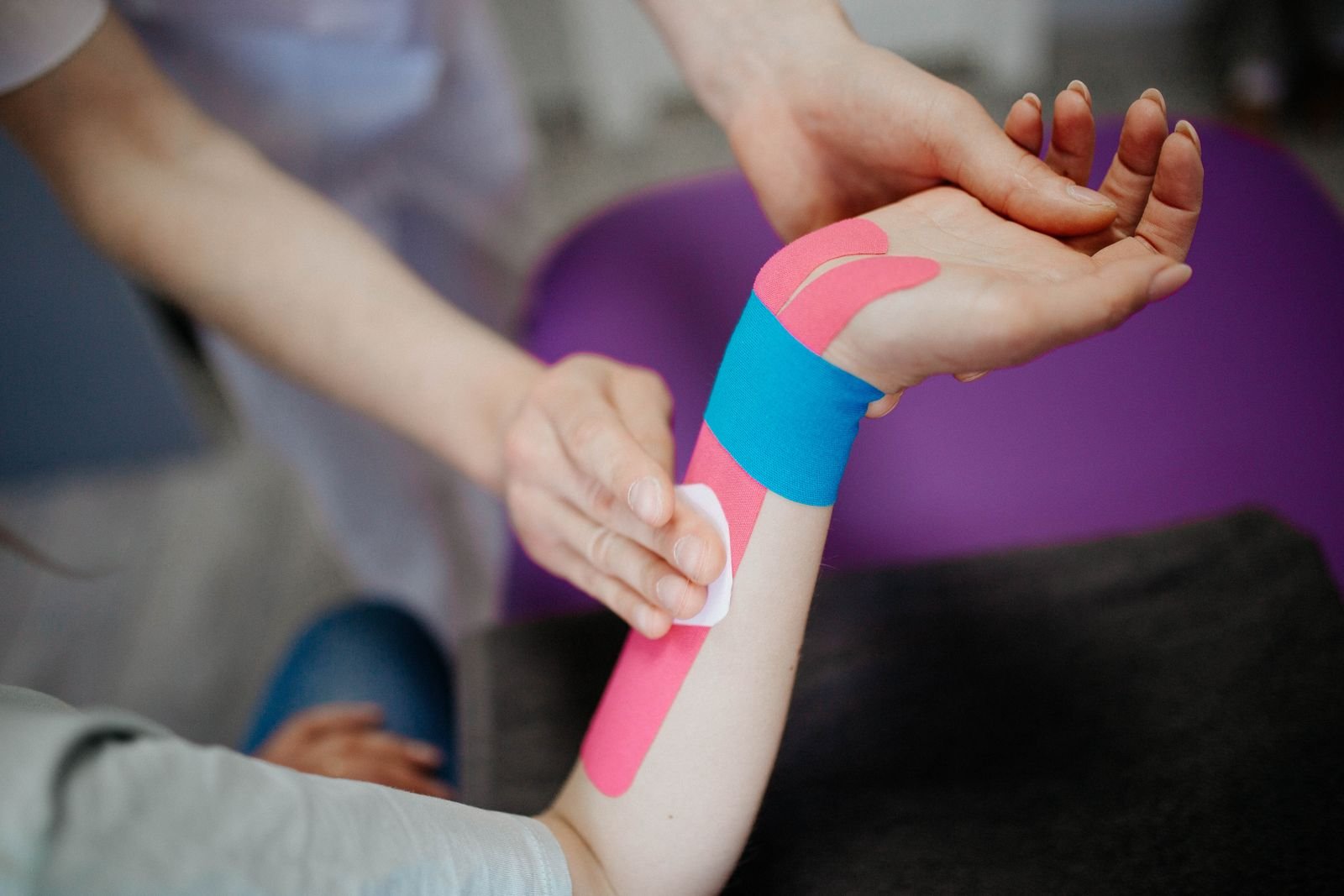
Ripping tape off quickly like a plaster is the most common cause of irritation. A gentler approach works much better. Start by loosening the adhesive. Many people find that applying baby oil or a gentle oil over the tape, waiting a few minutes, or removing it after a warm shower, makes it come away much more easily.
Then peel slowly, starting at one end and pulling in the direction of hair growth. As you peel, press down on the skin just behind the tape with your other hand, so you’re pulling the tape away from the skin rather than pulling the skin with the tape. Keep the tape low and close to the skin as you go, rather than pulling it upwards. Take your time over hairy areas or sensitive skin. Afterwards, wash the area gently, and if any adhesive residue is left, a little oil usually removes it.
Can You Reapply The Same Piece?
In short, no. Once kinesiology tape has been removed, the adhesive has been used and contaminated with skin cells, hair, and oils, so it won’t stick properly again. The fabric will also have lost some of its elasticity. Trying to reapply a used strip usually means it lifts quickly, doesn’t provide the same support, and can irritate your skin.
The same applies to edges that have peeled. Pressing them back down rarely works for long, and trimming the lifted edge off is usually better if the rest of the tape is still well stuck. If you need ongoing support, use a fresh piece. Many practitioners also recommend giving your skin a break of around a day between applications, particularly if you’re taping the same area repeatedly over several weeks.
What Impact Sports Rehabilitation Recommends
At Impact Sports Rehabilitation, we typically recommend leaving tape on for around three to five days if your skin is comfortable and the tape is still well stuck, then removing it gently and giving your skin a short break before reapplying if needed. For athletes training hard, a shorter wear time of two or three days is often more realistic, and for sensitive skin we may advise even shorter periods.
When we apply tape in clinic, we also show you how to remove it safely and, where appropriate, how to reapply it yourself at home. Tape is always one part of a wider plan rather than a treatment on its own, so we’ll explain how it fits in alongside your exercises and activity. You can find out more on our Rocktape taping page, and if you’re applying tape to an ankle yourself, our guide on how to tape a sprained ankle with kinesiology tape walks you through it step by step.
Free tool: Kinesiology Taping Selector
Taping it yourself? Our free kinesiology taping selector shows step-by-step patterns for the ankle, knee, shoulder, lower back and BJJ fingers, with the stretch and anchor points for each.
If you’d like tape applied by a practitioner and clear guidance on how to look after it at home, Impact Sports Rehabilitation in Eccles, Greater Manchester can help. We work with athletes and active people from Eccles, Salford, Trafford, and across Manchester, and online consultations are available if you’d like taping advice over video. Book in and we’ll make sure your tape works for you, not against your skin.
Frequently Asked Questions
Can I leave kinesiology tape on for a week?
Some people can, particularly with synthetic tapes or on areas that don’t move or sweat much, as long as the tape is still well stuck and the skin is comfortable. For most people, three to five days is a more typical range.
Can I shower with kinesiology tape on?
Yes, most kinesiology tapes are water-resistant. Pat the tape dry gently afterwards rather than rubbing it, and avoid using a hot hairdryer on it.
Why does my skin itch under kinesiology tape?
Mild, brief itching can happen as the tape settles, but persistent or worsening itching often means your skin isn’t tolerating the adhesive. If itching continues, or you notice redness or a rash, remove the tape.
Should I take kinesiology tape off at night?
Not usually, as it’s designed to be worn continuously for several days. If it feels uncomfortable in bed or catches on sheets, Impact Sports Rehabilitation can suggest a different application or shorter wear time.
What happens if I leave kinesiology tape on too long?
The tape is likely to lift and lose effectiveness, and the risk of skin irritation increases. Removing it once it starts peeling badly, or after around five days, is usually a sensible approach.
How soon can I put new tape on after removing the old one?
If your skin looks and feels normal, you can usually reapply fairly soon, but many people benefit from giving their skin a break of around a day. If there’s any redness or irritation, wait until it has fully settled.
This article is for educational purposes only and offers general guidance on kinesiology tape use. Individual experience varies, and skin irritation, itching, or a rash means tape should be removed regardless of wear time. Impact Sports Rehabilitation offers in-person and online consultations for taping advice and injury support.