This kinesiology taping guide shows you exactly how to tape the most common problem areas yourself: the ankle, knee, shoulder, lower back, and the finger and thumb injuries that come with gripping in BJJ. Choose an area and you will get the number of strips, the stretch to use, where to anchor, and a step-by-step pattern, the same way we talk clients through it in a Rocktape taping session.
Pick an area and the pattern appears instantly on this page. Nothing is stored or sent anywhere, there is no sign-up, and it is not a diagnosis.
Please note: this guide is general educational information. It does not diagnose, it is not a replacement for a professional assessment, and it cannot guarantee results for any individual. Kinesiology tape supports an injury, it does not treat an undiagnosed or unstable one. If you suspect ligament damage, a fracture or a joint that gives way, get it assessed before taping.
What do you want to tape?
| Rocktape | KT Tape (original) | |
|---|---|---|
| Adhesive | Stronger, grippier | Softer, gentler |
| Feels | Thicker, very sticky at first | Lighter on the skin |
| Often suits | Sweaty training, contact sports, grappling | Everyday wear, sensitive skin |
| Clinical evidence | No good evidence that either brand works better. Application and skin response matter more than the logo. | |
Typical wear time: 3 to 5 days for most areas, if it is still stuck down and your skin is comfortable. Fingers and very mobile joints usually less.
Take it off straight away if you notice itching, redness, a rash, blistering or more pain. To remove it, soak it with a little baby oil, then peel slowly in the direction of hair growth while pressing the skin down behind it.
Worked Example: Taping A BJJ Finger Or Thumb Grip Injury
- Area selected
- BJJ finger or thumb grip injury
- Strips
- 2 to 3 thin strips, 1 to 1.5cm wide
- Stretch
- 10 to 25% (light)
- Anchor
- Finger segment below the sore joint
- Direction
- An X across the palm side of the joint
- Cut a 5cm roll lengthways into thin strips and round the corners.
- Bend the finger slightly into a relaxed grip position.
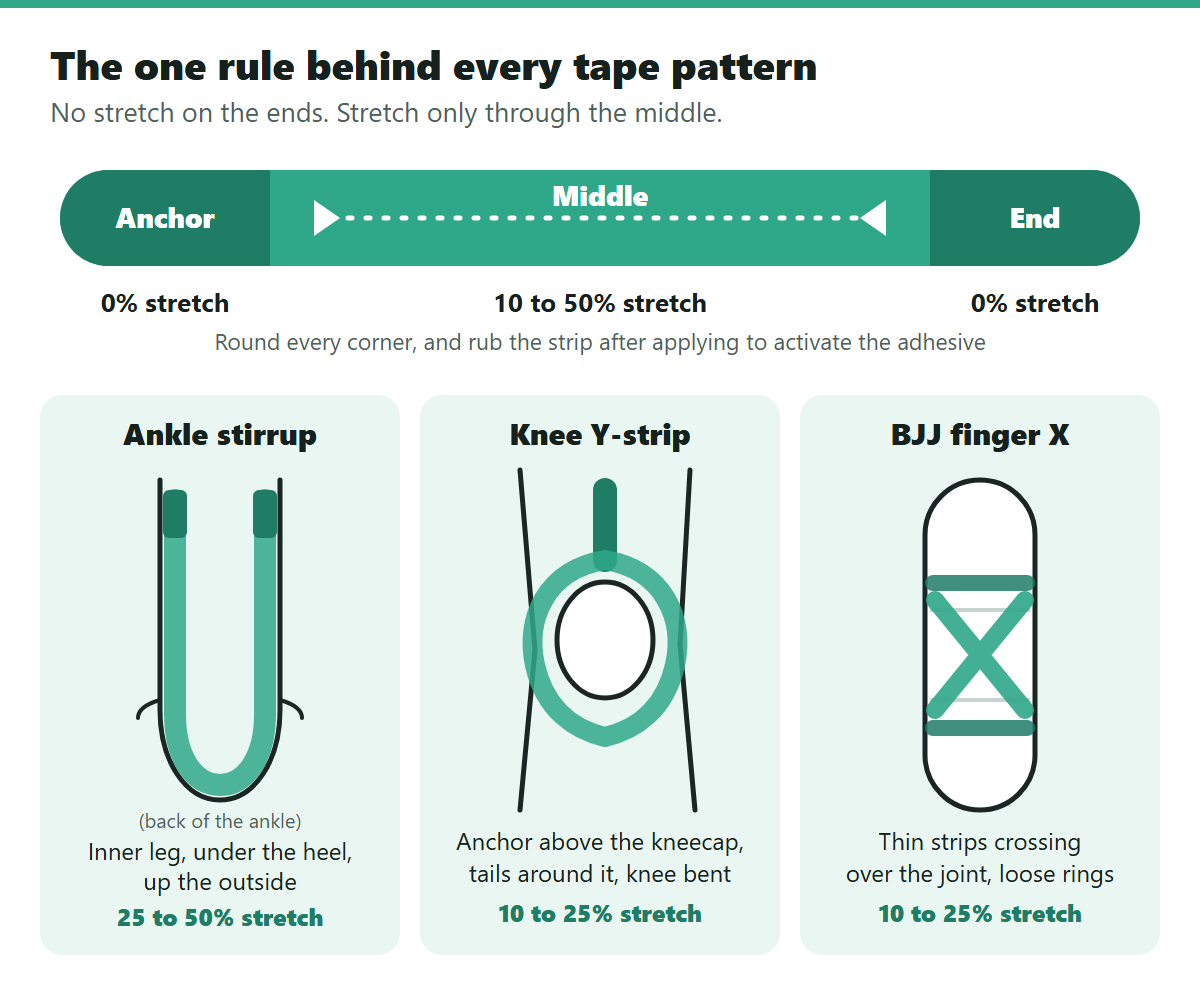
- Anchor the first strip on the side of the segment below the sore joint with no stretch, run it diagonally across the palm side of the joint with light 10 to 25% stretch, and finish on the opposite side of the segment above with no stretch.
- Lay the second strip the opposite way so the two cross in an X over the joint.
- For the thumb, anchor on the back of the wrist and wrap a figure-of-eight around the base of the thumb with light stretch.
- Finish with a light ring above and below the joint, applied with no stretch, and check the fingertip stays pink and warm.
Grip-specific tip: never wrap tight full circles around a finger, because swelling during a session can turn a snug ring into a tourniquet. Wear time: usually just the session, or up to a day.
Rocktape Vs KT Tape, Which One Actually Works Better
This is the question we get asked most, so here is the honest answer: there is no good evidence that either brand produces better results. Both are elastic kinesiology tapes built on the same idea, with a stretchy fabric and a heat-activated, wave-pattern adhesive that lets your skin breathe. Both stretch to well over their resting length, both come in rolls and pre-cut strips, and both are water-resistant enough to shower in.
Where they differ is mostly feel. Many people find Rocktape’s adhesive grippier, and it tends to hold better through sweaty training, contact sports and grappling. The flip side is that it can feel very sticky at first and be a little harsher on sensitive skin. KT Tape’s original version usually feels softer and gentler, which some people prefer for everyday wear, while its synthetic range is built to last longer in water and sweat.
In the interest of transparency, we use Rocktape in clinic at Impact Sports Rehabilitation, mainly because it stays put through the kind of training our clients do. That is a practical preference, not proof it works better. In our experience, how well the tape is applied, and how your skin reacts to it, make far more difference than the logo on the roll. If you want the full breakdown, our Rocktape vs KT Tape comparison goes into more detail.
How Long To Leave Kinesiology Tape On, The Honest Answer
For most areas, with a good application on clean, dry skin, around three to five days is a sensible guide. Some people get a week out of a strip on a flat, low-sweat area like the lower back. Others find tape on an ankle or knee starts lifting within a day or two, especially with hard training. And finger tape for grappling usually lasts a single session, because hands sweat, grip and get washed constantly.
The rule that sits above any number is that your skin is the boss. Take tape off straight away if you notice itching, redness, a rash, blistering or more pain, however long it has been on. A quick daily check helps. If the edges are flat and the skin looks normal, carry on. If one corner has lifted, trim it. If more than a third of the strip has come up, it is time for a fresh one.
A few habits make tape last longer: apply it around an hour before training or a shower so the adhesive can bond, round every corner, keep the ends free of stretch, and pat it dry rather than rubbing it with a towel. When it is time to remove it, soak it with a little baby oil and peel it back slowly along the skin rather than ripping it upwards. Our guide on how long to leave kinesiology tape on covers this in more depth.
Why BJJ Grip Injuries Need Their Own Taping Approach
Most taping guides cover big joints like knees and shoulders and stop there. Fingers rarely get a mention, which is odd when you consider how many grapplers tape their fingers before every session. Gi grips put the small joints, ligaments and tendon pulleys of the fingers under heavy, repeated load in bent positions, and that creates a different set of problems from a sprained ankle or a sore shoulder.
The first difference is size. Standard 5cm tape is far too wide for a finger, so you need to cut thin strips, around 1 to 1.5cm. The second is function. A finger that is taped straight and stiff is useless for gripping, so finger patterns need to support the sides of the joint while still letting it bend, which is exactly what the X pattern does. The third is safety. Fingers swell easily during training, and a tight full ring of tape that felt fine at the start can cut off circulation an hour later. That is why every finger pattern here uses light stretch and loose rings, and why checking the fingertip colour matters.
It is also worth knowing when kinesiology tape is not the right choice. Many grapplers use rigid finger tape or buddy taping for a sprained finger in live rolling because it gives more mechanical support. Kinesiology tape tends to suit the in-between stage: when the finger is improving and you want comfort and support without losing your grip. And if a finger looks bent, the tip will not straighten, or a tendon seems to lift away from the bone when you grip, tape is not the answer. Get it assessed. At our Rocktape taping sessions we regularly tape fingers, thumbs and wrists for BJJ and other grip sports, and can show you how to do it yourself between sessions.
Want your taping done properly the first time, or shown how to do it yourself? Book a Rocktape taping session with Impact Sports Rehabilitation in Eccles, or an online consultation if you are further away.
Frequently Asked Questions
Does kinesiology tape actually work, or is it just a placebo?
The research is mixed. Kinesiology tape does not repair tissue, but many people find it makes an area feel more supported and comfortable, and it can improve awareness of a joint while you move. We see it as a useful supporting tool alongside rehab, not a treatment on its own.
How much should I stretch the tape?
Less than most people think. Anchors and ends always go on with no stretch, and the middle usually needs light to moderate stretch, somewhere around 10 to 50% depending on the area. Over-stretching is one of the most common reasons tape irritates the skin or peels off early.
Can I tape my ankle before I know how bad the sprain is?
It is better not to. If you could not walk four steps after the injury, the bones are tender to press, or the swelling is severe, get it assessed first, as some sprains involve fractures or significant ligament damage. Tape is for supporting an injury you understand, not for masking one you do not.
What tape is best for BJJ fingers?
It depends on the stage. For a recently sprained finger in live rolling, many grapplers prefer rigid finger tape or buddy taping for more support. As it improves, thin strips of kinesiology tape in an X pattern give support while letting you grip. Whatever you use, avoid tight full circles around the finger.
Can I shower or swim with kinesiology tape on?
Yes, both main brands are water-resistant. Pat the tape dry afterwards rather than rubbing it, and avoid a hairdryer on a hot setting. Repeated soaking does shorten how long it lasts, especially on hands and feet.
Can Impact Sports Rehabilitation tape me before a competition?
Yes. Impact Sports Rehabilitation offers Rocktape taping sessions in Eccles, and we can tape you for training or competition and show you how to reapply it yourself. If the area has not been assessed yet, we will check it first so the taping actually suits the injury.
This kinesiology taping guide from Impact Sports Rehabilitation is for general educational purposes only. It does not diagnose any condition and is not a substitute for professional medical diagnosis or treatment. Kinesiology tape is a supportive tool and should not be used on an undiagnosed or unstable injury, broken or irritated skin, or if it causes discomfort. Follow the manufacturer’s guidance and remove the tape if your skin reacts.