
This ACWR calculator shows you, in seconds, whether you are ramping your training up too fast. Enter your training load for the last four weeks and it works out your acute:chronic workload ratio, then shows which zone you are in: undertraining, the sweet spot, caution or high risk. No email, no download, just your answer on the page.
Your ratio appears instantly on this page. No email, no sign-up, and nothing you enter is stored or sent anywhere. It is a training guide, not a diagnosis.
Please note: the ACWR is a widely used but imperfect screening tool. This calculator gives general educational information only. It does not diagnose, it is not a replacement for a professional assessment, and it cannot predict or guarantee anything about your individual injury risk.
Calculate your ACWR
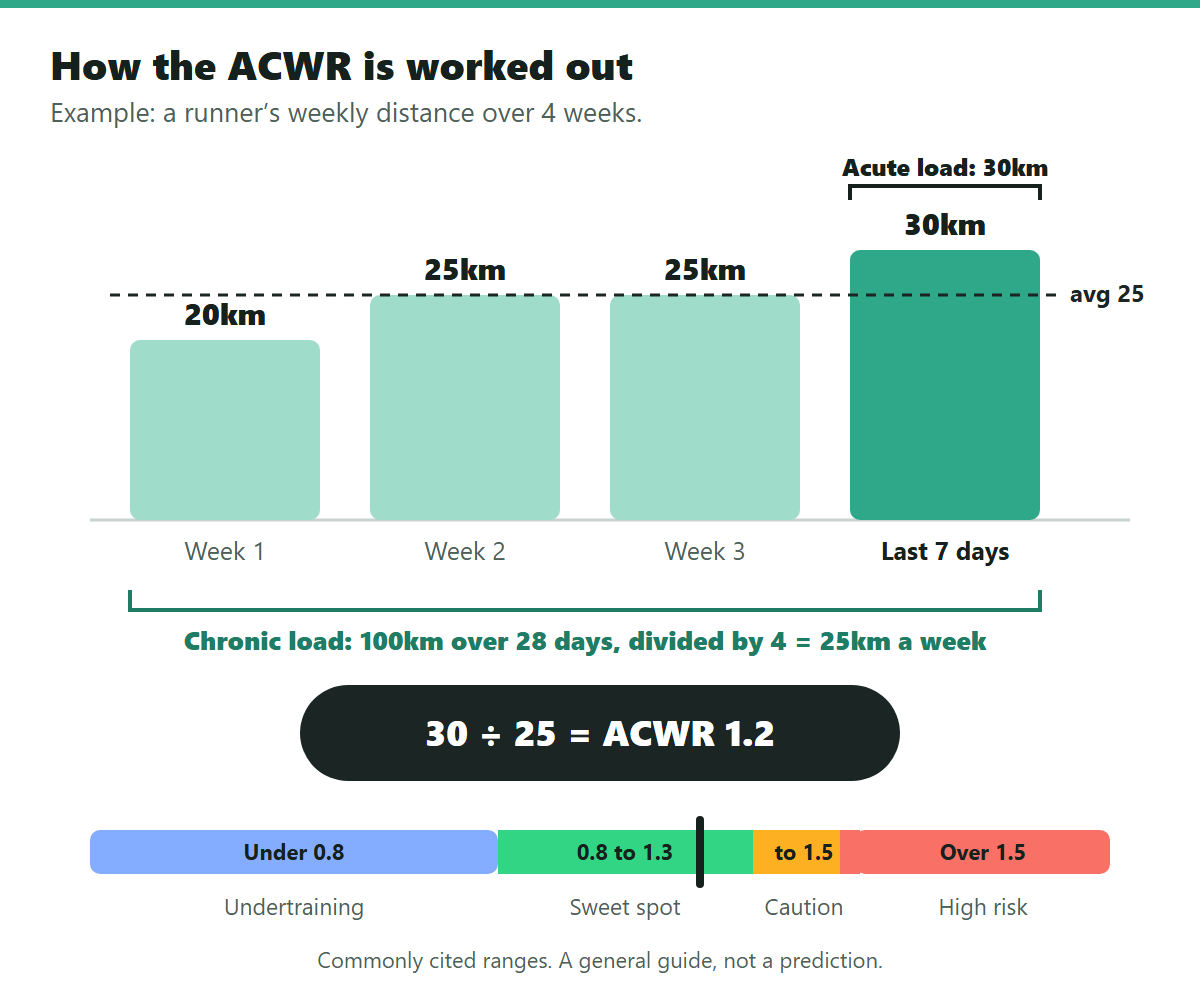
Worked Example: A Runner Building Up To 30km A Week
- Last four weeks
- 20km, 25km, 25km, then 30km in the last 7 days
- Acute load
- 30km (the last 7 days)
- Chronic load
- 25km (100km over 28 days, divided by 4 weeks)
- ACWR
- 30 divided by 25 = 1.2, the sweet spot
A ratio of 1.2 means this week is 20% above your recent weekly average. Many coaches use roughly 0.8 to 1.3 as a general guide to a sensible range for steady progress, so this runner is building at a pace their body is broadly used to. A rough ceiling for next week would be about 32.5km (1.3 times the 25km average). Had they jumped to 45km this week instead, the 4-week average would have risen to 28.75km and the ratio would have been about 1.57, in the high risk zone.
What The Acute:Chronic Workload Ratio Actually Measures
Your acute load is what you have done recently, usually the last 7 days. Think of it as your current fatigue. Your chronic load is your average week over a longer window, usually the last 28 days, and it roughly reflects your fitness: what your body has been prepared for. The ratio simply divides one by the other.
Neither number tells you much on its own. Forty kilometres in a week is a huge jump for someone used to 15, and a light week for someone used to 60. The ratio puts this week in the context of what you are actually conditioned for, which is why many coaches find it more useful than raw mileage or hours.
The zones this calculator uses come from commonly cited research in team sports. A ratio of roughly 0.8 to 1.3 is generally considered the sweet spot. Below 0.8 suggests you are doing much less than usual, which is fine for a deload but can mean lost fitness if it goes on, and a sudden jump back up from a low base is where risk tends to rise. Between about 1.3 and 1.5 is a caution zone, and above 1.5 is the range most often linked with a higher chance of injury.
It is worth being honest about the limitations. The ACWR has been debated in sports science, partly because of how the two numbers are calculated (this tool uses the simple rolling average method, where the last 7 days are part of the 28 day average) and partly because injury has many causes. It works best as an early-warning flag that prompts a sensible conversation, not as a precise risk score.
Why This Calculator Gives You An Answer Instantly, No Email Required
Search for an ACWR calculator and one of the top results asks for your name and email address before it will send you a downloadable spreadsheet. There is no result on the page at all. You hand over your details, wait for an email, open a file, and then work out how to use it. For a calculation that is genuinely one division, that is a lot of hoops.
We think that gets it the wrong way round. If you are wondering whether you have ramped up too fast, you want the answer now, while you are planning next week, not after a sign-up process. So this calculator runs entirely in your browser. You type in your numbers, press the button and see your ratio and zone immediately. Nothing you enter is stored or sent anywhere, and there is no list you are being added to.
It also means the explanation is right here on the page rather than locked in a download. You can see exactly how the ratio is calculated, what the zones mean and where the method falls short, which is just as useful to you as the number itself. If you want to track it week to week, simply come back and enter your latest four weeks.
What To Actually Do If You’re In The Caution Or High Risk Zone
First, do not panic. A high ratio is a nudge to adjust, not a sign that an injury is coming. The simplest move is to hold your load steady for a week or two rather than adding more, which lets your chronic load catch up and brings the ratio back down naturally. If you have just had a very big week, a slightly lighter one next is generally considered sensible.
Spread your training more evenly where you can. One huge long run or one brutal session can spike your acute load on its own, so breaking it up across the week tends to be easier on your body. Keep an eye on how you feel too. Unusual soreness that does not settle, niggles that appear during sessions, poor sleep and dropping performance are all worth taking seriously alongside the number.
If you are coming back from an injury, building towards an event, or keep running into the same niggles, a structured plan makes a big difference. At a rehabilitation consultation, Impact Sports Rehabilitation can look at your training history, any problem areas and your goals, then help you build a load progression that gets you there without the spikes. We are based in Eccles, near Salford, Trafford and Manchester, and offer online consultations too.
Want a training progression that builds fitness without the risky spikes? Book a rehabilitation consultation with Impact Sports Rehabilitation in Eccles, or online if you are further away.
Frequently Asked Questions
What is a good ACWR?
A ratio of roughly 0.8 to 1.3 is generally considered the sweet spot, meaning your current week is broadly in line with what your body is used to. Above about 1.5 is the range most often linked with a higher chance of injury. These are general guides from research, not hard limits.
Is the ACWR actually reliable, or has it been debunked?
It is debated rather than debunked. Researchers have questioned how it is calculated and how strongly it predicts injury, since injury has many causes. In our experience it is still a useful, simple flag for sudden spikes in training, as long as you treat it as one data point among many.
What should I use as my training load?
Whatever you track consistently. Runners often use distance, and many sports use minutes. Session load, which is your effort out of 10 multiplied by the session length in minutes, works for almost any sport and accounts for how hard sessions felt, not just how long they were.
Why do I need four weeks of data?
Your chronic load is your average week across 28 days, so the calculator needs four weeks to compare your last 7 days against. With less data, the comparison is less meaningful. If one of your weeks was genuinely zero, enter zero. If you just have not got the data, the ratio will look higher than it really is.
Can a low ACWR be a problem too?
It can. A ratio well below 0.8 means you are doing much less than usual. That is fine for a deload or taper, but long periods at a low load reduce fitness, and jumping straight back to full training from there creates exactly the kind of spike the ratio is designed to catch.
Can Impact Sports Rehabilitation help me plan my training load?
Yes. Impact Sports Rehabilitation regularly helps runners, footballers and gym-goers build sensible load progressions, especially when they are returning from injury or keep picking up the same niggles. We can assess any problem areas and set out a progression with you, in Eccles or online.
This ACWR calculator from Impact Sports Rehabilitation is for general educational purposes only. The acute:chronic workload ratio is an imperfect screening tool and does not diagnose, predict or guarantee anything about your individual injury risk. It is not a substitute for professional medical diagnosis, advice or treatment. If you have pain or an injury, please seek an assessment from a qualified professional.