Quick answer: Rotator cuff rehab typically progresses through general stages, starting with restoring pain-free movement, then gentle strengthening, and eventually building back up to heavier load and, where relevant, overhead or sport-specific demands. Many people find rehab genuinely effective, though the right pace and specific exercises depend on your particular injury and should come from a proper assessment. This is general education, not a personalised treatment plan.
If you’ve been told you’re dealing with a rotator cuff issue, the phrase “just do some rotator cuff exercises” only gets you so far without understanding what rehab actually involves and why the order matters, and why the same exercise list handed to two different people can produce two very different results. Here’s a plain-language overview of what rotator cuff rehab typically looks like, stage by stage.
What The Rotator Cuff Is And What It Does
The rotator cuff is a group of four muscles and their tendons, the supraspinatus, infraspinatus, teres minor, and subscapularis, that wrap around the shoulder joint, working together to keep the ball of the upper arm bone properly centred in its socket while also helping power and control shoulder movement. Each of the four plays a slightly different role, the supraspinatus helps initiate lifting the arm out to the side, the infraspinatus and teres minor control outward rotation, and the subscapularis controls inward rotation, which is part of why symptoms and function can look genuinely different depending on which specific part of the cuff is involved.
Because the shoulder is built for a genuinely huge range of motion rather than deep bony stability, the rotator cuff does a lot of the quiet, constant work of keeping the joint controlled, particularly during overhead movement, throwing, or grappling positions where the arm is loaded away from the body.
Rotator cuff issues range from irritation and tendinopathy, ongoing overuse-related changes in the tendon without a structural tear, through to partial or full tears, and the specific problem genuinely affects what a sensible rehab approach looks like. Tendinopathy often responds well to a progressive loading approach on its own, while a genuine tear, particularly a larger or full-thickness one, may need a different pace or, in some cases, surgical input, which is exactly why a proper assessment matters before starting any programme rather than assuming every rotator cuff problem is treated identically.
The General Stages Rotator Cuff Rehab Typically Follows
Rotator cuff rehab typically moves through broad stages rather than a single fixed exercise list. Early on, the priority is usually calming irritation and restoring pain-free movement rather than building strength. Once movement has genuinely improved, gentle strengthening work is usually introduced, gradually building toward heavier, more demanding load, and eventually, where relevant, sport-specific movement patterns like overhead throwing or grappling positions.
How quickly someone moves between these stages varies considerably and should be guided by how the shoulder is genuinely responding, not a fixed calendar, which is exactly why working with a therapist who can reassess and adjust the plan tends to produce better results than following a generic timeline found online.
Early-Stage Exercise Categories
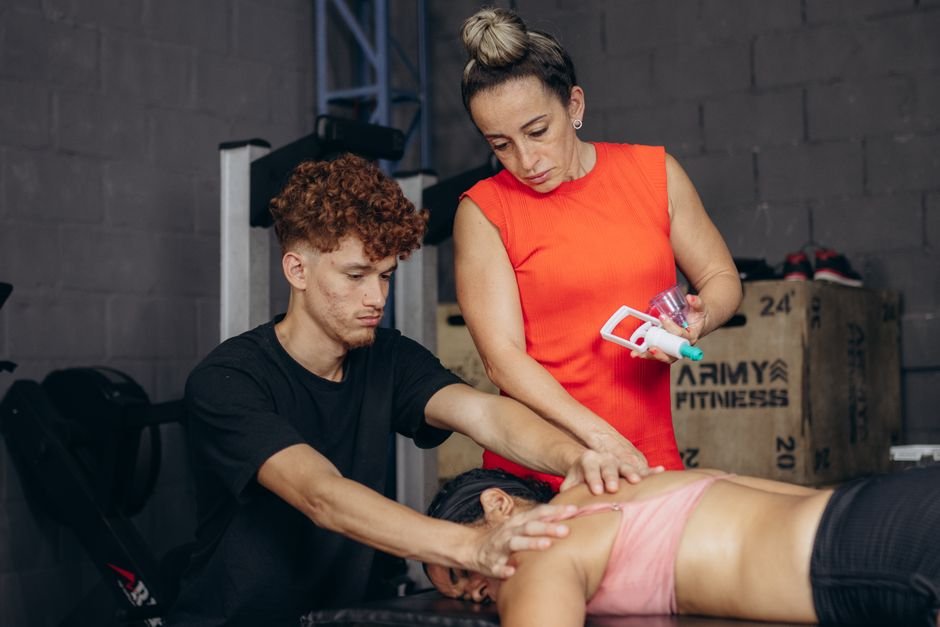
Early-stage rotator cuff rehab typically focuses on gentle range-of-motion work, moving the shoulder through a pain-free arc without loading it heavily, alongside isometric exercises, where the muscle contracts without the joint actually moving. Isometric work is a genuinely useful early tool since it can help reduce pain and maintain some muscle activation without demanding the kind of movement that might aggravate an irritated tendon.
Posture and shoulder blade control are also commonly addressed early on, since how the shoulder blade moves during arm elevation genuinely affects how much stress ends up on the rotator cuff tendons themselves. Pain during this stage is typically used as a guide rather than something to push through entirely, many people find working within a mild, tolerable level of discomfort during exercise is more productive than either avoiding movement altogether or forcing through sharp pain, both of which can slow progress in different ways.
Later-Stage Exercise Categories
Once pain-free movement has been restored, rehab typically progresses to resistance-band and light weighted strengthening work targeting the rotator cuff and surrounding shoulder muscles directly, gradually increasing load as the shoulder tolerates it. Later still, this can build toward heavier strengthening and, for people returning to overhead sport, throwing-specific or grappling-specific movement patterns that more closely mimic the actual demands of the activity. Exercises at this stage often move beyond simple, single-plane movements toward more functional, multi-directional work, since real overhead sport and grappling rarely demand strength in just one straight line, and rebuilding capacity in the actual positions your activity requires tends to matter more the closer you get to a full return.
This progression is deliberately gradual because the tendon tissue itself needs time to adapt to increasing load, rushing this stage is a genuinely common reason rehab stalls or symptoms flare back up, which is covered in more detail below.
For someone recovering from a genuine tear, particularly following surgical repair, later-stage progression tends to run considerably more cautiously than for tendinopathy alone, since the repaired tendon-to-bone healing site needs a protected window before it can safely tolerate meaningful resisted load. This is another reason a generic exercise list found online can be genuinely unhelpful, or even counterproductive, without knowing which specific situation you’re actually recovering from.
Common Mistakes People Make With Rotator Cuff Rehab
One of the most common mistakes is starting proper strengthening work too early, before pain-free movement has genuinely been restored. Well-researched rehab protocols are specific about this, strengthening is generally held off until active shoulder elevation is close to normal, often cited as being able to lift the arm actively above roughly 120 degrees, and internal rotation has recovered to a meaningful degree compared with the unaffected side, rather than simply “whenever it feels a bit better.” This specific benchmark is a genuinely useful thing to know, since a lot of general rotator cuff content skips straight to listing exercises without explaining that timing and readiness matter just as much as which exercise you’re doing. Someone with an early, irritated tendon doing the same aggressive strengthening work as someone much further along in recovery is a genuinely common way symptoms get worse rather than better.
The other frequent mistake sits at the opposite end of rehab, returning to full training, throwing, or heavy overhead activity too quickly once the shoulder starts feeling noticeably better. A shoulder that feels fine for a day or two of light activity hasn’t necessarily rebuilt the capacity to handle a full return to demanding sport, and rushing this final stage is a genuinely common reason people end up back where they started, sometimes with a worse setback than the original problem. Form matters too, reaching for heavier resistance before technique is solid, or letting the shoulder blade shrug or wing during band work, both reduce how effectively the exercise actually targets the rotator cuff. Rushing through repetitions rather than controlling the movement on the way back down is another common technique slip, since the controlled, lowering phase of a strengthening exercise is often where a meaningful amount of the actual training benefit comes from.
What To Expect When You Book An Assessment With Impact Sports Rehab
At Impact Sports Rehabilitation, a rotator cuff assessment looks at exactly where your shoulder is at, rather than assuming everyone starts and progresses at the same pace. This runs alongside our coverage of biceps tendonitis exercises, a closely related structure that’s often involved alongside the rotator cuff, and our coverage of labrum tear shoulder recovery, for readers dealing with a related structure that helps stabilise the same joint. Since these three structures often work together and can be involved at the same time, it’s genuinely worth mentioning any symptoms beyond the shoulder itself, such as biceps or upper arm discomfort, at your assessment rather than assuming they’re unrelated.
If you’re dealing with a rotator cuff issue and want a rehab plan built around where your shoulder genuinely is, Impact Sports Rehabilitation works with clients across Eccles, Trafford, and Salford. Ask about an online consultation if you’re further afield.
Frequently Asked Questions
Will I need surgery for my rotator cuff?
Not necessarily, many rotator cuff issues, particularly tendinopathy and some partial tears, respond well to a structured rehab programme without surgery. Whether surgery is genuinely appropriate for your specific injury depends on factors only a proper assessment can determine.
How long does rotator cuff rehab typically take?
This varies considerably depending on the specific injury and how it responds, so we wouldn’t want to give a fixed timeline without knowing your situation. In our experience, meaningful progress usually takes weeks rather than days, and a full return to demanding overhead activity often takes longer still.
When is it safe to go back to overhead sport or lifting?
This depends on rebuilding genuine strength and control through the full range your sport demands, not just being pain-free at rest, so it’s worth getting a proper assessment before returning rather than guessing based on how the shoulder feels day to day. Returning too early is one of the more common reasons symptoms come back.
Can I keep training other body parts while my shoulder recovers?
Often yes, many people find they can keep training areas that don’t aggravate the shoulder, though this genuinely depends on your specific injury and stage of rehab. It’s worth checking with whoever is guiding your rehab before assuming any particular exercise is safe.
My shoulder feels better already, do I still need to keep doing the exercises?
Feeling better and having fully rebuilt the strength and control the rotator cuff needs aren’t always the same thing, so stopping early is a genuinely common reason symptoms return once activity ramps back up. Sticking with a full programme, rather than stopping once pain settles, tends to produce better long-term results.
This article is provided for general educational purposes by Impact Sports Rehabilitation and does not constitute medical advice, diagnosis, or treatment, and does not diagnose the reader’s specific injury. Rotator cuff rehab should be guided by a qualified physiotherapist, sports therapist, or doctor based on individual assessment.