
Quick answer: Knee pain going up stairs is commonly linked to how the kneecap tracks and is loaded during the strong quadriceps contraction needed to lift your body weight against gravity, often grouped under the general term patellofemoral pain. Weakness or imbalance in the quadriceps and hip muscles is a frequently cited contributing factor. This pattern has several possible underlying causes, so it’s worth understanding properly rather than assuming, and a proper assessment is the right next step for ongoing symptoms.
Noticing your knee complaining specifically when you climb stairs, rather than during other activities, is a genuinely useful clue, and it’s worth understanding what that specific pattern tends to point toward. Knee pain going up stairs has a fairly recognisable set of common causes, here’s an honest breakdown.
How Climbing Stairs Loads The Knee
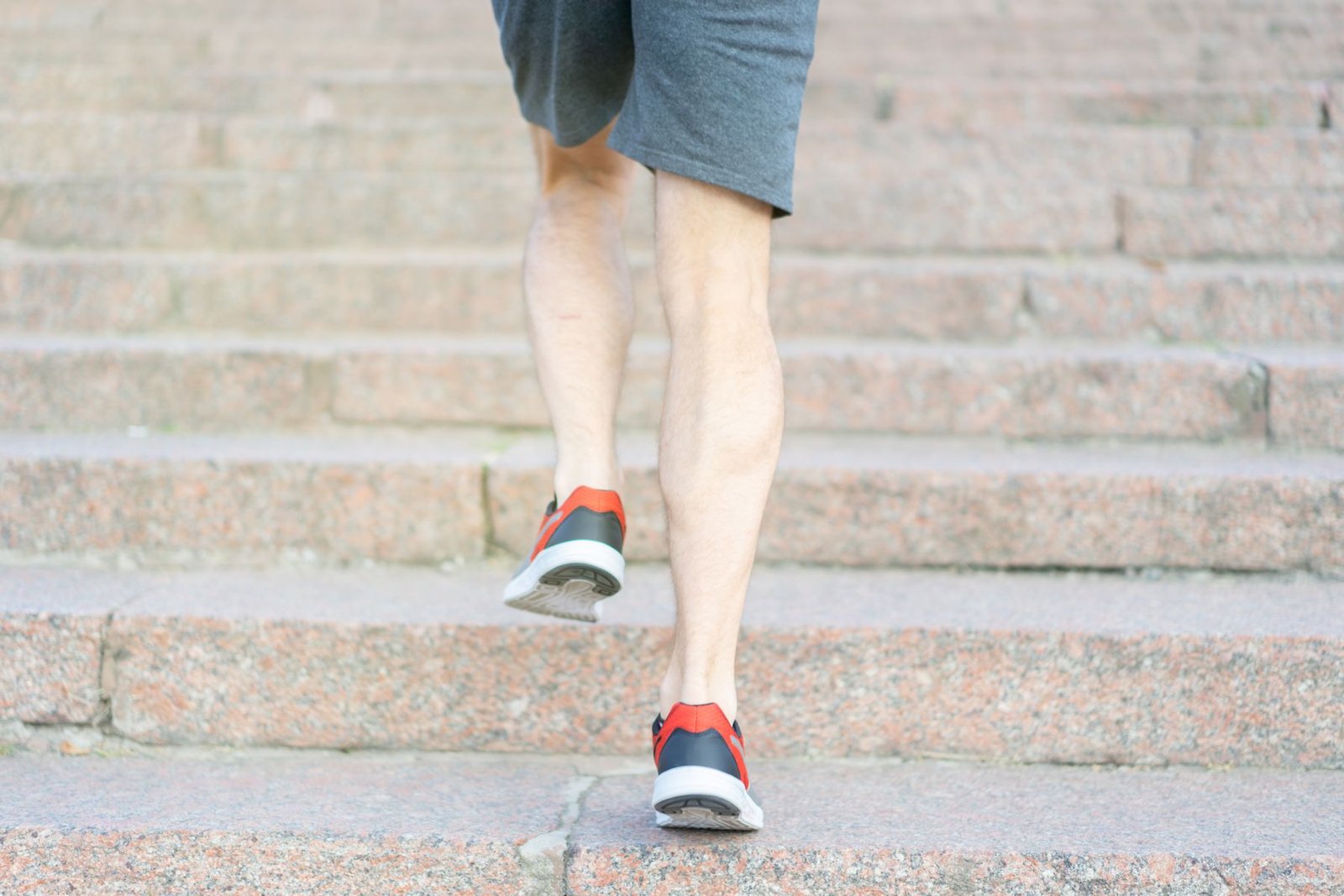
Climbing a step requires your quadriceps and glutes to contract strongly to lift your entire body weight upward against gravity, and this specific movement significantly compresses the kneecap against the thigh bone beneath it. This load is considerably higher than level walking, which is a large part of why stairs specifically, rather than flat ground, tend to bring on symptoms that otherwise stay quiet.
Because this demand falls heavily on the quadriceps and the kneecap’s tracking within its groove, issues affecting either of these, muscle weakness, imbalance, or how the kneecap moves, tend to show up most clearly during exactly this kind of loaded, bent-knee movement.
This is genuinely why symptoms can feel confusing, the knee might feel completely fine walking on flat ground, doing everyday tasks, or even during some gym exercises, yet flare up reliably and specifically on stairs. That specificity isn’t random, it reflects how much higher the load on the kneecap genuinely is during this particular movement compared to most other daily activities, rather than suggesting the problem is somehow inconsistent or hard to pin down.
Common Conditions Associated With Pain Specifically On The Way Up
Pain on the way up stairs is frequently associated with what’s broadly termed patellofemoral pain, an umbrella term for discomfort related to how the kneecap tracks and loads against the thigh bone, rather than a single specific diagnosis. Contributing factors commonly include weakness in the quadriceps or hip muscles, since these muscles play a genuine role in controlling how the kneecap tracks during movement, and imbalance between different parts of the quadriceps can also affect this tracking.
Cartilage-related changes underneath the kneecap, sometimes an early, milder softening rather than significant wear, are another recognised contributor in some cases, along with tendon-related irritation just below the kneecap in people who do a lot of jumping or explosive loaded activity. Outer knee and thigh tightness or irritation, sometimes related to IT band knee pain, running down the outside of the thigh, can also contribute to a broadly similar pattern in some people, though this tends to have its own distinct set of contributing factors worth understanding separately.
General Self-Management Approaches People Often Try
Many people find temporarily modifying how they use stairs, taking them one at a time rather than two, or leaning slightly forward to reduce the angle the knee bends through, genuinely helps manage symptoms while addressing the underlying cause. Targeted strengthening, particularly of the quadriceps and hip muscles, is commonly used as a general approach, since improving how these muscles control the kneecap tends to help this specific pattern more than rest alone.
Activity modification, temporarily reducing particularly aggravating loaded activities like running or jumping while symptoms settle, alongside the strengthening work, is a commonly used general approach, though what’s appropriate for you specifically should come from a proper assessment rather than a generic online list.
Footwear is worth checking too, worn-out or unsupportive shoes can subtly change how load is distributed through the lower limb during stair climbing, and a genuinely supportive pair can be a small but meaningful part of an overall management approach. Paying attention to how your knee tracks during the movement itself, some people find consciously keeping the knee aligned over the second toe rather than letting it drift inward helps, though this is worth confirming applies to your specific pattern rather than assuming.
How This Pattern Differs From Pain Going Down Stairs
It’s genuinely useful to understand that pain specifically on the way up and pain specifically on the way down often point toward a related but distinct pattern. Going up relies mainly on a shortening, concentric quadriceps contraction lifting your weight upward, while going down relies on a lengthening, eccentric contraction controlling your weight downward, a mechanically different demand that tends to load the kneecap differently.
Some people notice pain with both directions, which doesn’t necessarily mean two separate problems, often the same underlying tracking or loading issue shows up across both movements, just via a different mechanism each way. Understanding which direction genuinely bothers you most, and reading more about knee pain when going down stairs if that is your pattern, is a useful piece of information to bring to an assessment.
Paying attention to which direction is genuinely worse, and whether that’s changed over time, can also be a useful thing to mention at an assessment, since it helps your practitioner understand the specific loading pattern involved rather than starting from a general description of “knee pain on stairs” alone.
When To Get Stair-Related Knee Pain Assessed
Pain that’s persistent, worsening, or accompanied by swelling, a sense of the knee giving way, or a locking or catching sensation is worth getting properly assessed rather than continuing to self-manage indefinitely. Pain that’s stopping you from managing normal daily stair use, not just more demanding activity, is also a reasonable trigger to seek assessment rather than working around it long-term. A gradual worsening trend over several weeks, rather than staying stable or improving, is another useful signal that self-management alone isn’t sufficiently addressing whatever’s actually driving the pattern.
What To Expect When You Book An Assessment With Impact Sports Rehab
At Impact Sports Rehabilitation, an assessment for stair-related knee pain looks at kneecap tracking, quadriceps and hip strength, and movement pattern, to identify what’s actually contributing to your specific presentation before building a targeted plan. This often includes practical guidance alongside a staged rehabilitation consultation, addressing the underlying strength and control issues rather than just working around the symptom.

If stairs keep aggravating your knee, Impact Sports Rehabilitation works with clients across Eccles, Trafford, and Salford on genuinely targeted assessment and rehab. Ask about an online consultation if you’re further afield.
Frequently Asked Questions
Does knee pain on stairs mean something is structurally wrong?
Not necessarily, this pattern is often related to muscle strength and kneecap tracking rather than significant structural damage, though a proper assessment is the only reliable way to know what’s actually going on for your specific knee. Many people improve meaningfully with targeted strengthening once the underlying contributor is identified.
Should I keep using stairs normally, or avoid them?
Complete avoidance usually isn’t necessary, and temporary modifications, like taking stairs one at a time, are often more practical than avoiding them altogether. A physiotherapist or sports therapist can advise on what’s sensible for your specific situation while you work on the underlying cause.
How long does this kind of knee pain typically take to improve?
This varies by individual and the underlying cause, so we wouldn’t want to guess a fixed timeline without an assessment. Many people notice gradual improvement with consistent, targeted strengthening work over several weeks, though your own timeline may differ.
Is this the same as runner’s knee?
“Runner’s knee” is a common informal name for patellofemoral pain, the same general pattern often associated with stair-related knee pain, though you don’t need to be a runner to experience it. A proper assessment can clarify what’s specifically contributing to your symptoms regardless of what it’s informally called.
Will strengthening exercises alone fix this?
For many people, targeted strengthening of the quadriceps and hip muscles genuinely helps this pattern considerably, though the right specific exercises and progression depend on your individual presentation. A proper assessment helps make sure you’re targeting the right areas rather than guessing from a generic list.
This article is provided for general educational purposes by Impact Sports Rehabilitation and does not constitute medical advice, diagnosis, or treatment, and does not diagnose the cause of your specific symptoms. Always seek the guidance of a qualified physiotherapist, sports therapist, or doctor for individual assessment and diagnosis, and stop and seek professional advice if you experience worsening pain, numbness, or swelling.