This return-to-sport readiness quiz is an honest gut-check for anyone coming back from an injury and itching to get back to training or matches. It asks eight plain-language questions based on the same principles clinicians use, and tells you whether you look ready to progress back, close but not quite there, or better off getting assessed first, with the specific gaps named.
Your result appears instantly. Nothing you answer is stored or sent anywhere, there is no sign-up, and it is not a diagnosis or medical clearance.
Please note: this quiz is general educational information and a self-reflection aid. It does not diagnose, it is not a replacement for a professional assessment, and a “ready” result is not medical clearance. If you are returning from a significant injury, such as surgery, a fracture or a ligament tear, get a professional assessment before resuming full training, whatever the quiz says.
Are you ready to go back?
Worked Example: Strong And Pain-Free, But Hesitant When Sprinting
- Answers
- Not a significant injury. Full, pain-free range and no flare-ups after training. Strength matches the other side and full sessions feel solid. Sport movements “mostly” at full speed, with hesitation when sprinting. One or two full sessions done. Mostly trusts it, and sometimes hesitates.
- Result
- Close, but not quite there yet
The gaps to work on: full-speed sport movements and trust. The hesitation during sprinting is worth addressing with a gradual return-to-running progression (jogging, then strides, then sprints, then sprinting with changes of direction) before going back to full training. Building confidence in controlled sessions first usually means the hesitation fades, and you move the way you did before the injury.
Pain-free movement and strength both look good, which is a great foundation. This is not medical clearance, just a sign of where to focus next.
The Four Things That Actually Determine Readiness, Not Just Pain
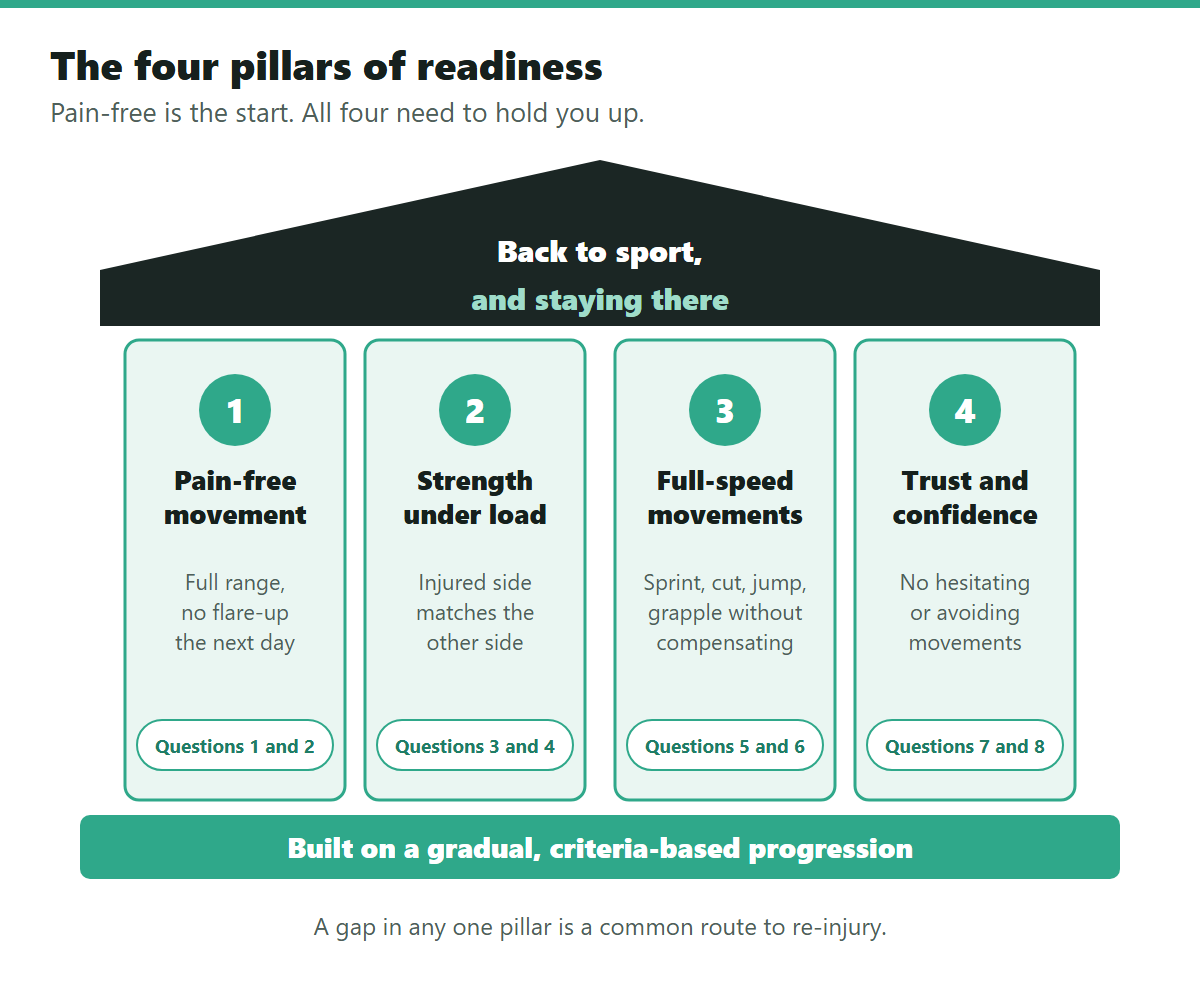
The most common way people decide they are ready to go back is simple: it does not hurt any more. Pain-free is genuinely important, and it is the first pillar in this quiz, but it is the starting line rather than the finish. Pain often settles well before strength, control and confidence have fully returned.
The second pillar is strength and confidence under load. After an injury, the injured side is very often weaker than the other, even when it feels fine day to day. Clinicians measure this with strength tests and hop tests, comparing one side with the other. In plain terms, the question is simple: can the injured side do everything the good side can, on your hardest exercises, without feeling weak or wobbly?
The third is sport-specific movement. Your sport asks for things daily life does not: sprinting, cutting, jumping and landing, throwing, or the scrambles of grappling. Being able to do those at full speed, without limping, favouring the other side or quietly changing your technique, is a big step beyond being able to jog in a straight line.
The fourth, and the most overlooked, is psychological readiness. Do you trust the injured area when things get unpredictable, or do you find yourself holding back and avoiding certain movements? Research on returning to sport after injury consistently highlights confidence and fear of re-injury as major factors in whether people return successfully, and hesitation matters for a very practical reason: it changes how you move.
Why Rushing Back Early Is The Single Biggest Cause Of Re-Injury
A previous injury is one of the strongest predictors of a future one, and much of that comes down to people going back before they are fully ready. The problem is that a pain-only self-check misses most of the things that are still missing. If you only ask “does it hurt?”, you will not notice that your injured leg is 20% weaker, or that you have started landing on the other foot without thinking about it.
Compensation is sneaky. After an injury, your body naturally protects the sore area by shifting load elsewhere: pushing off harder with the good leg, turning on one side only, gripping with the other hand. In daily life you never notice. At full speed, under fatigue, late in a match, those compensations put extra strain on the injured area when it is least prepared, and on the parts doing the extra work. That is exactly when many re-injuries happen.
Psychological hesitation feeds into this. If you do not trust your knee, you may not fully commit to a cut, which changes your mechanics and can actually increase strain on the joint. Research on athletes returning after ligament injuries suggests those who feel more confident and less fearful tend to return more successfully, while people who return based on time alone, rather than on meeting clear criteria, tend to have higher re-injury rates. That is why this quiz asks about trust and avoidance alongside pain and strength, and why a gap in any one pillar is worth closing before going back fully.
What A Guided Return-To-Sport Plan Looks Like
A guided return is built on criteria, not just dates. At a rehabilitation consultation with Impact Sports Rehabilitation, we start by assessing where you are on each of these pillars: range of movement, strength compared with the other side, how you move through sport-specific drills, and how confident you feel. That gives us an honest picture of what is ready and what is not.
From there, we build a step-by-step progression. It typically moves from strength and control work, to running and change-of-direction drills, to sport-specific training without contact, then full training, and finally competition. Each stage has clear markers, so you know exactly what you need to be able to do before moving on, and you are not just guessing or waiting for an arbitrary date.
We also work on the confidence side deliberately, exposing you to the movements you are wary of in a controlled way so trust returns alongside strength. Hands-on treatment like sports massage can help along the way. We work with runners, footballers, gym-goers and combat-sports athletes from our clinic in Eccles, near Salford, Trafford and Manchester, and offer online consultations too.
Want to go back with confidence, and stay back? Book a rehabilitation consultation with Impact Sports Rehabilitation in Eccles, or online, for a criteria-based return-to-sport plan.
Frequently Asked Questions
How do I know if I’m ready to return to sport after an injury?
Look beyond pain. As a general guide, you want full pain-free movement, strength on the injured side close to the other side, the ability to do your sport’s key movements at full speed without compensating, and genuine trust in the area. If any of those is missing, it is usually worth closing the gap first.
It doesn’t hurt any more. Isn’t that enough?
Unfortunately not. Pain often settles before strength, control and confidence have returned, and those gaps are what tend to cause re-injury. Being pain-free is the first box to tick, not the last.
What are return to play criteria?
They are the specific markers clinicians use to decide when someone is ready to go back, rather than relying on time alone. They usually cover range of movement, strength compared with the other side, functional tests like hopping and cutting, sport-specific drills, and psychological readiness. This quiz turns those principles into plain-language questions.
I feel nervous about getting injured again. Is that normal?
Very normal, and worth taking seriously rather than ignoring. Fear of re-injury can make you hesitate and move differently, which is why confidence is one of the four pillars here. Gradually practising the movements you are wary of, in controlled training first, usually helps trust return.
Do I need clearance after surgery or a fracture?
Yes. After a significant injury such as surgery, a fracture, a dislocation or a ligament tear, please get a professional assessment before returning to full training, regardless of how you feel or what this quiz says. A clinician can test things a self-check cannot.
Can Impact Sports Rehabilitation help me return to sport safely?
Yes, it is a big part of what we do. Impact Sports Rehabilitation assesses where you are, builds a criteria-based progression from rehab to full competition, and works on confidence as well as strength. You can see us in Eccles or book an online consultation.
This return-to-sport readiness quiz from Impact Sports Rehabilitation is for general educational purposes only. It is a self-reflection aid, not medical clearance, and it does not diagnose any condition or guarantee that you will avoid re-injury. It is not a substitute for professional medical diagnosis or treatment. After a significant injury, please get a professional assessment before resuming full training.