
Quick answer: In the Rocktape vs KT Tape debate, both are elastic kinesiology tapes built on the same basic idea, and there’s no good evidence that either brand produces better clinical results. The practical differences are mostly about feel: many people find Rocktape’s adhesive grippier and better suited to sweaty, hard training, while KT Tape’s standard version often feels softer on the skin, with synthetic options for longer wear. How well the tape is applied, and how your skin responds, usually matters more than the logo on the roll.
If you’re comparing Rocktape vs KT Tape, you’ve probably noticed that most comparisons online read a lot like adverts. One brand is described as the obvious winner, often by a site that sells it, and the real question, whether the choice actually makes a difference to your injury, gets skipped. We want to give you a more honest answer.
In the interest of transparency, we use Rocktape in clinic at Impact Sports Rehabilitation. We’ll explain why later in the article, but we’ll be just as clear that this is a practical preference rather than proof that one tape works better than the other. We’ve used both brands, and both can be good options. In this guide we’ll cover what the two tapes have in common, where they genuinely differ, how they compare on stickiness, stretch, and wear time, whether the brand changes the clinical effect, and how to choose what’s right for you.
Rocktape Vs KT Tape: What They Actually Have In Common
Both Rocktape and KT Tape are kinesiology tapes, stretchy tapes designed to move with your skin rather than restrict your joints. They’re fundamentally different from rigid sports tape, which is used to limit movement, for example when strapping an ankle before a match. Kinesiology tape aims to provide a sense of support, improve awareness of a joint or muscle, and make movement feel more comfortable.
Both brands use an elastic fabric backed with a heat-activated adhesive arranged in a wave pattern, which allows air and moisture to escape. Both stretch to roughly one and a half to nearly twice their resting length, both come in rolls and pre-cut strips, and both are water-resistant enough to wear in the shower. They’re also applied using the same basic principles: clean skin, rounded corners, no stretch on the ends, and more or less stretch through the middle depending on the goal. In other words, the similarities are much bigger than the differences.
Where Rocktape And KT Tape Differ In Practice
Where they differ is mostly in how they feel and how they behave on the skin. Rocktape’s standard tape is often described as thicker, with a noticeably stronger adhesive. Many athletes like this because it tends to stay put through sweaty training, contact sports, and repeated movement. The flip side is that some people find it feels very sticky at first, and it can be a little harsher on sensitive skin when removed.

KT Tape’s original cotton version is generally considered softer and gentler, which some people prefer for everyday wear or for sensitive skin. KT Tape also offers synthetic versions, designed to last longer and cope better with water and sweat. Rocktape has its own variations too, including versions aimed at water sports and sensitive skin. Both brands update and expand their ranges, so it’s always worth checking the specific product rather than assuming all tapes from one brand behave the same.
Both also sell pre-cut strips and kits aimed at specific areas, such as knees, shoulders, or ankles. Pre-cut strips save time and come with rounded corners already, which makes them a good option if you’re new to taping, while a continuous roll is usually better value and gives you more flexibility to cut lengths for your own body. Practitioners tend to prefer rolls for that reason, as no two legs or shoulders are quite the same size.
Stickiness, Stretch, And Wear Time Compared
Stickiness is where most people notice the biggest difference. In our experience, Rocktape tends to hold more firmly during sweaty or high-movement activities, while KT Tape’s original version can feel more comfortable but may lift sooner during hard training. Synthetic options from either brand usually hold up better in water and sweat.
Stretch is broadly similar between the two. Both offer enough elasticity for common taping techniques, and differences in feel are small compared with the effect of how much stretch the person applying it uses.
Wear time is often quoted at around three to five days for standard tapes, with some synthetic versions claiming longer. In reality, how long tape lasts depends heavily on skin type, sweating, showering, hair, application technique, and where on the body it’s placed. A strip over a bending joint, such as the knee or ankle, usually lifts sooner than one on the back. Our guide on how long to leave kinesiology tape on covers this in more detail.
Does The Brand Actually Change The Clinical Effect?
This is the question most brand comparisons avoid, so here’s our honest answer: there’s no good evidence that one major brand of kinesiology tape produces better clinical outcomes than another. We’re not aware of any meaningful research directly comparing Rocktape and KT Tape for pain, function, or recovery.
More broadly, research on kinesiology tape as a whole is mixed. Some studies suggest it may help with short-term pain relief or comfort for certain conditions, while others find little difference compared with placebo taping. Many people do report feeling more supported and confident with tape on, and that can help them move and exercise more comfortably, which has value in itself. But that effect seems to come from taping in general rather than from a specific brand. Our article on whether kinesiology tape actually works goes into the evidence in more depth.
What does seem to matter more is application technique, choosing the right technique for the problem, how your skin tolerates the tape, and whether taping is part of a wider plan that includes exercise and appropriate load. A well-applied tape from either brand is likely to be more useful than a poorly applied one from the other.
If you want to know whether tape helps you personally, a simple test is more useful than reading brand claims. Pick a movement that bothers you, such as a squat, a calf raise, or reaching overhead, and rate how it feels out of ten. Apply the tape, wait a few minutes, and repeat the same movement. If it feels noticeably more comfortable or you feel more confident, the tape may be worth using during that phase of your recovery. If you notice no difference after a couple of tries, it may simply not be the right tool for you, whichever brand you’re using.
Why Impact Sports Rehabilitation Uses Rocktape
We use Rocktape in clinic for practical reasons. Many of our clients are runners, footballers, gym-goers, and combat sports athletes who sweat heavily and train hard, and we’ve found Rocktape’s adhesive holds up well for multi-day wear through that kind of activity. Our team is also very familiar with how it handles and stretches, which helps us apply it consistently from one session to the next, and consistency is an important part of good taping.
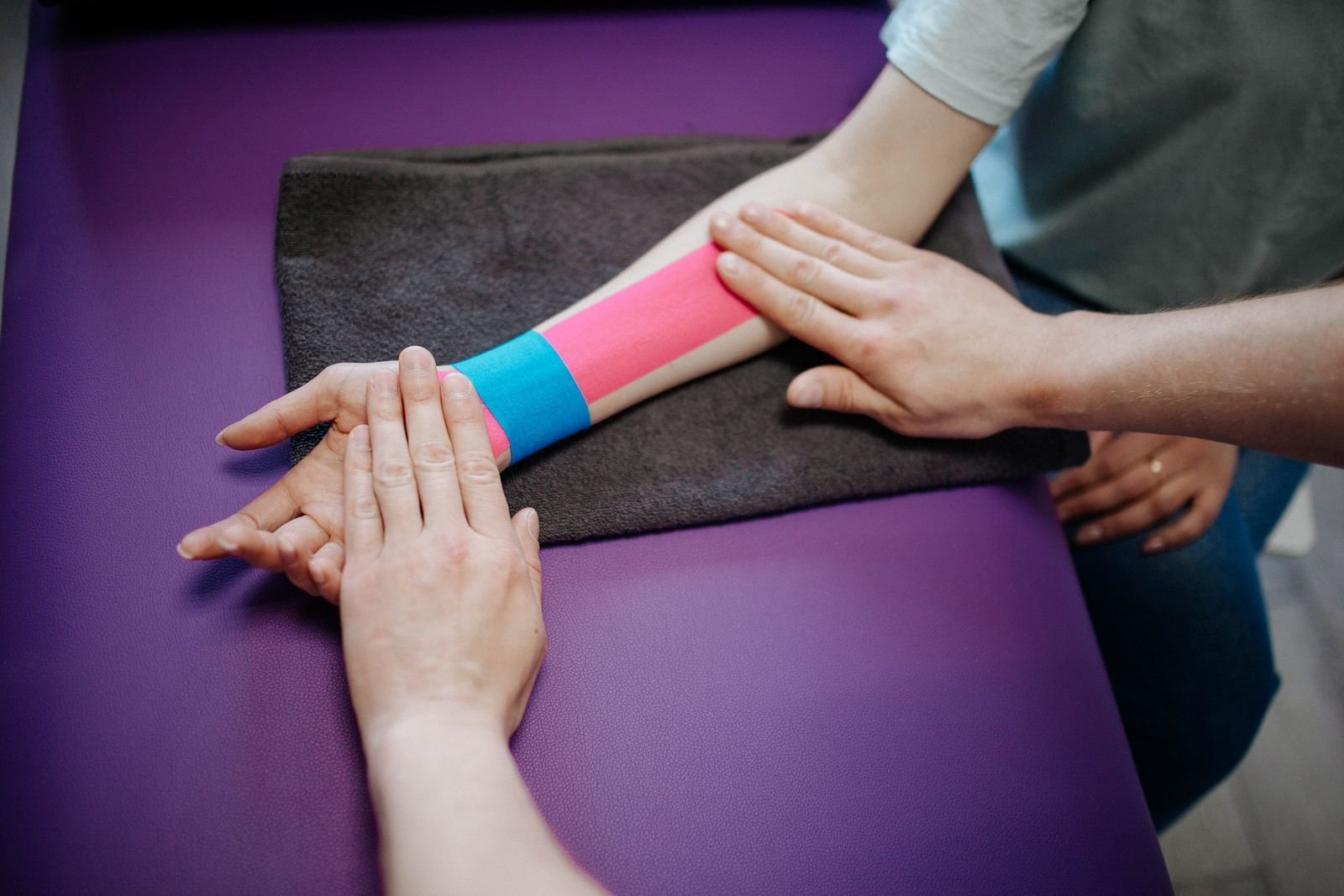
That doesn’t mean Rocktape is the right choice for everyone. If someone has sensitive skin, we’ll adapt our approach, and if a client already uses another brand at home and gets on well with it, there’s usually no reason to switch. You can find out more about how we use taping on our Rocktape taping page.
Choosing Between Rocktape Vs KT Tape For You
If you train hard, sweat a lot, or want tape that stays on through repeated sessions, many people find Rocktape’s stronger adhesive suits them. If you have sensitive skin, want something softer for everyday wear, or find stronger adhesives irritating, KT Tape’s original version may be more comfortable. If water or long wear time is a priority, look at the synthetic or water-focused options from either brand.
Before using either tape for an extended period, it’s sensible to do a small patch test on your skin for a day.
Cost is worth considering too. If you’re taping regularly, a full roll is usually much cheaper per application than pre-cut packs. Be cautious with unusually cheap listings on large online marketplaces, as counterfeit or poor-quality versions of well-known tapes do circulate, and these are more likely to lose their stickiness quickly or irritate the skin. Buying from the brand’s own shop or a reputable retailer avoids most of that risk. Above all, focus on learning a good technique for your specific problem, ideally from a practitioner, as that’s what makes the biggest difference. If you’re taping a sprained ankle, our step-by-step guide on how to tape a sprained ankle with kinesiology tape walks through it in detail.
Free tool: Kinesiology Taping Selector
Taping it yourself? Our free kinesiology taping selector shows step-by-step patterns for the ankle, knee, shoulder, lower back and BJJ fingers, with the stretch and anchor points for each.
If you’d like advice on taping, or want a practitioner to apply it and show you how to do it yourself, Impact Sports Rehabilitation in Eccles, Greater Manchester can help. We work with athletes and active people from Eccles, Salford, Trafford, and across Manchester, and online consultations are available if you’d like taping guidance over video. Book in and we’ll help you get the most from your tape, whichever brand you use.
Frequently Asked Questions
Is Rocktape better than KT Tape?
Not in terms of proven clinical results, as there’s no good evidence that one brand works better than the other. Many people find Rocktape stickier for hard training and KT Tape’s original version softer, so the best choice often comes down to preference.
Which tape lasts longer, Rocktape or KT Tape?
It depends on the specific product, your skin, and your activity. Rocktape’s standard tape often holds well during sweaty training, while synthetic versions from either brand are designed for longer wear.
Can I use KT Tape if my physio uses Rocktape?
Usually yes, as the basic application principles are the same. Impact Sports Rehabilitation is happy to show you how to apply whichever brand you prefer at home.
Which tape is better for sensitive skin?
Many people with sensitive skin find softer tapes or versions designed for sensitive skin more comfortable. Patch testing for a day before longer use is a sensible way to check how your skin reacts.
Does expensive kinesiology tape work better than cheap tape?
Not necessarily in terms of effect, but cheaper tapes can vary in adhesive quality and may lift sooner or irritate skin more. Choosing a reliable product that suits your skin is usually more important than price.
Do I need tape at all to recover from an injury?
No, tape is an optional supportive tool rather than a treatment on its own. Recovery is mainly driven by appropriate exercise, load management, and time, with tape sometimes helping you feel more comfortable along the way.
This article is for educational purposes only and reflects general information and our own practical experience. Individual experience and preference vary, and taping is not a substitute for proper assessment and treatment of an injury. Impact Sports Rehabilitation uses Rocktape in clinic and offers in-person and online consultations.