
Quick answer: Safe achilles tendonitis exercises usually start with gentle isometric holds to calm irritable pain, then progress to eccentric calf loading as the tendon settles, building strength gradually over several weeks. Many people find rushing straight to heavy loading before the early stage has calmed down is what turns a manageable tendonitis into a longer-term problem. Sudden sharp pain, an audible pop, or being unable to rise onto your toes at all are signs of a possible tendon tear, not tendonitis, and need urgent medical assessment rather than exercise.
Achilles pain has a way of nagging at you every single step, especially first thing in the morning or right after a run. The instinct is often to either push through it or rest completely and hope it goes away, and neither approach tends to work particularly well on its own. What actually helps is a staged plan of achilles tendonitis exercises that respects where your tendon is right now, rather than jumping straight to the exercises that worked for someone else’s recovery.
What’s Actually Happening To Your Achilles Tendon
Achilles tendonitis develops when the tendon connecting your calf muscles to your heel bone is asked to handle more load than it’s currently capable of tolerating, repeatedly, without enough recovery in between. This is usually a gradual overload injury rather than a single dramatic moment, often building up over weeks of increased running volume, a sudden return to training, or a change in footwear or surface.
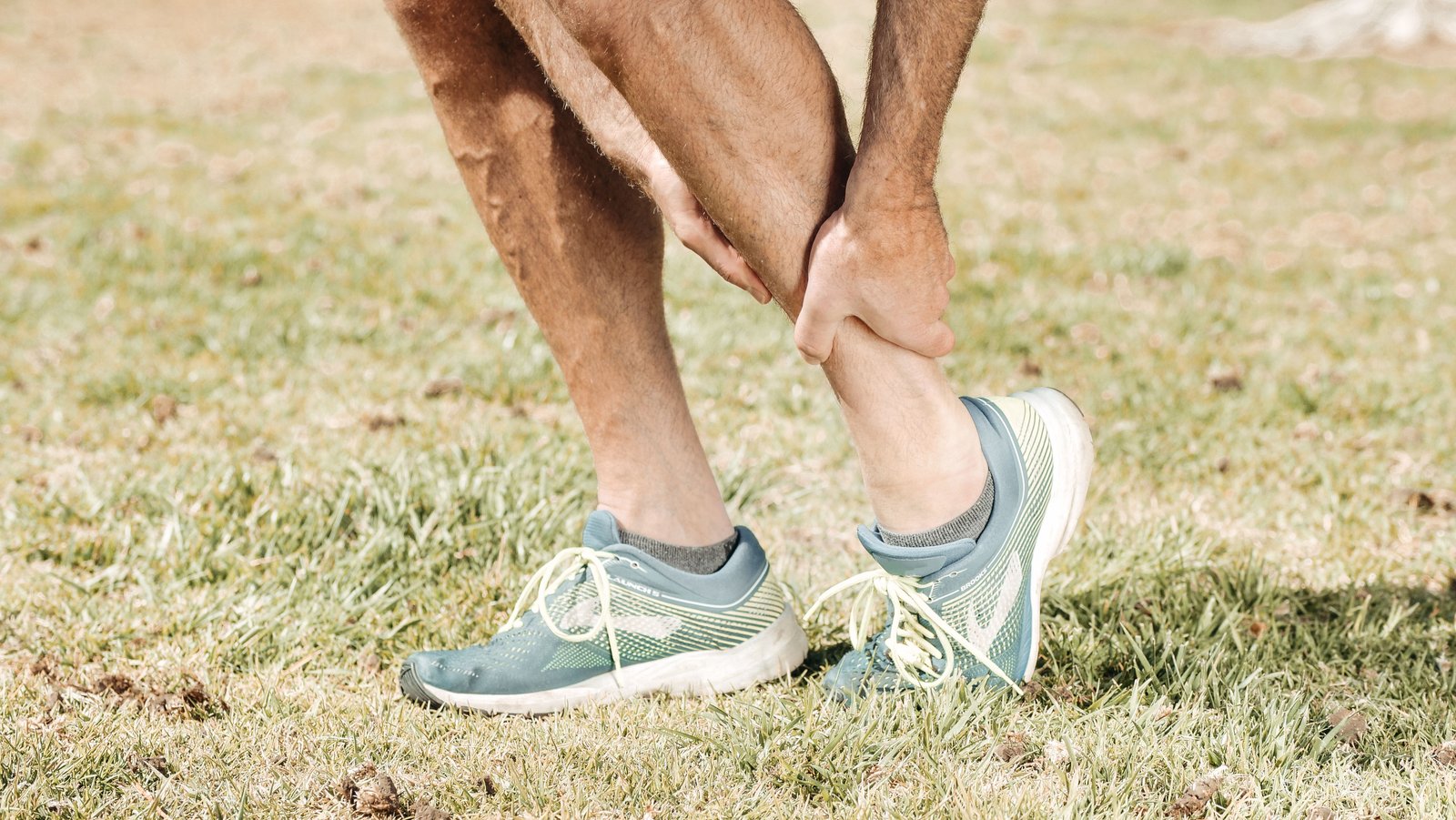
The pain typically shows up as stiffness and tenderness a few centimetres above the heel, often worse first thing in the morning or after periods of rest, and it tends to ease slightly once you’re warmed up, only to return later. That pattern, better with gentle movement, worse with load or after rest, is fairly characteristic of tendon irritation rather than something more acute.
It’s worth being clear about where the line sits. Achilles tendonitis is an overload and irritation problem, and it responds well to a graded exercise approach. A tendon tear or rupture is a different injury entirely, and it needs medical assessment before any exercise programme, not instead of one. Sudden sharp pain, a feeling or sound like a pop or snap, significant swelling that comes on suddenly, or an inability to rise up onto your toes at all are the signs that point toward a possible rupture rather than tendonitis, and they mean you should get assessed urgently rather than starting the exercises below.
Early-Stage Exercises To Calm Things Down
When the tendon is genuinely irritable, meaning pain is present with normal daily activity or flares easily, the goal isn’t to load it hard, it’s to calm it down without losing all the strength you already have. Isometric calf holds, pushing up onto your toes and holding the position for thirty to forty-five seconds without movement, are often a good starting point, since sustained holds tend to be better tolerated by an irritable tendon than repeated up-and-down movement.
Gentle range-of-motion work for the ankle, simple circles and controlled flexing and pointing of the foot, keeps things moving without adding meaningful load. Many people find doing isometric holds two or three times a day, a few repetitions each time, genuinely takes the edge off pain within the first week or two, though this varies with how irritable the tendon is to begin with.
A useful way to judge whether this stage is appropriate for you is simple: if standing on one leg and rising onto your toes is genuinely too painful to attempt, or the pain is severe rather than a manageable ache, that’s worth getting checked before starting rather than pushing through it.
Strengthening Exercises To Fix The Root Cause
Once the tendon has settled from its most irritable state, progressive loading is what actually addresses the underlying problem rather than just managing symptoms. Eccentric calf raises, slowly lowering your heel down from a raised position over a count of three to five seconds, are central to tendon rehab because tendons respond particularly well to controlled, slow loading under tension.
A typical progression starts with eccentric raises on flat ground with both legs, moves to single-leg eccentric lowering as strength improves, and eventually progresses to doing the same movement off the edge of a step, which increases the range and load further. Most clients work through roughly three sets of ten to fifteen slow repetitions, a few times a week, adjusting the difficulty as symptoms allow rather than following a fixed weekly jump in intensity.
Building general calf strength alongside the eccentric work, through standard two-footed and then single-leg calf raises, rounds out the strengthening stage and helps the tendon tolerate the return to running that comes later.
How To Know You’re Progressing Correctly
This is where most exercise lists for Achilles tendonitis leave people genuinely stuck, because knowing an exercise exists isn’t the same as knowing whether the pain you’re feeling during it is fine or a warning sign. A practical framework many clinicians use is scoring pain during the exercise out of ten, and treating anything up to around three or four as acceptable loading discomfort, as long as it settles back to its baseline level within twenty-four hours.
Pain that climbs higher than that during the exercise, or pain that’s noticeably worse the next morning than it was the day before, is a sign to back off the load or volume rather than push through it. This doesn’t mean stopping exercises altogether, it usually means reducing the range, the resistance, or the number of repetitions until the tendon settles back to its previous level, then progressing again more gradually.
Morning stiffness is another useful marker to track over time. If it’s gradually reducing week to week, that’s a genuinely good sign the tendon is adapting, even if day-to-day pain still fluctuates a little depending on activity.
How A Guided Program From Sports Rehab Helps
Achilles tendonitis exercises work best when the loading, the progression speed, and the exercise selection are actually matched to your tendon’s current tolerance, rather than following a generic printed sheet that assumes everyone’s starting point is the same. A Rehabilitation Consultation at Impact Sports Rehabilitation builds exactly this kind of personalised progression, adjusting the plan as your tendon’s tolerance genuinely changes rather than sticking rigidly to a preset timeline.
Sports massage is often used alongside the exercise programme to manage calf tightness that can otherwise place extra strain on the tendon, and Rocktape kinesiology taping is sometimes introduced during the return-to-running phase to provide extra support and feedback as training load increases again. Many clients find having someone check their actual tendon tolerance, rather than guessing from how many weeks have passed, makes the difference between a smooth recovery and a repeat flare-up.
Getting Back To Running Pain-Free
Once strengthening exercises are well tolerated with minimal next-day soreness, a gradual return to running usually starts with short, easy efforts on flat ground, well below your previous training volume, rather than jumping straight back into your old routine. Walk-run intervals are a common starting point, with the running portion increasing gradually as the tendon proves it can handle each new step up in load.
Research suggests that maintaining some form of calf and tendon loading exercise even after returning to running helps reduce the chance of the tendonitis flaring back up, rather than dropping the exercises the moment running feels comfortable again. Hills, speed work, and harder surfaces are generally the last things to reintroduce, since they place the greatest demand on the tendon.
In our experience, the athletes who return most reliably are the ones who treat the early running sessions as a test of the tendon’s tolerance rather than a return to full training, adjusting the next session based on how the tendon responds over the following day or two.
If you want a genuine, staged plan instead of a generic list of achilles tendonitis exercises, Impact Sports Rehabilitation works with runners and athletes across Eccles, Salford, Trafford, and the wider Greater Manchester area on exactly this, once anything more serious has been ruled out. Ask about an online consultation if you’re further afield.
Frequently Asked Questions
Is it safe to keep running through Achilles pain or will I make it worse?
It depends on how irritable the tendon currently is, mild discomfort that settles quickly can sometimes be manageable, but pushing through genuinely sharp or worsening pain often does make things worse and slows recovery down. If you’re unsure, easing off and starting with the early-stage exercises above rather than continuing to run at full volume is usually the safer choice.
How do I know if it’s tendonitis and not something more serious like a tear?
Tendonitis tends to build gradually and feels like stiffness and aching that eases with gentle movement, whereas a tear or rupture usually involves a sudden sharp pain, sometimes an audible pop, and real difficulty rising onto your toes. If you experienced anything like that, it’s worth getting assessed urgently rather than assuming it’s ordinary tendonitis.
Why does my Achilles hurt more in the morning than during the day?
Morning stiffness is a very typical pattern with Achilles tendonitis, since the tendon tightens up overnight and needs a bit of gentle movement to loosen before it feels normal again. Many people find this eases somewhat once they’re up and moving, only to return again after long periods of sitting or rest.
Do I really need to do the exercises even if the pain isn’t that bad?
Yes, in our experience mild, manageable Achilles tendonitis is exactly the stage where a proper exercise progression makes the biggest difference, since it’s much easier to fully resolve at this point than after months of on-and-off pain. Skipping the exercises because it “isn’t that bad yet” is a common reason tendonitis becomes a longer-term recurring issue.
How long until I can get back to normal training?
This varies quite a bit depending on how long the tendon has been irritated and how consistently the loading programme is followed, with some people progressing over several weeks and others needing longer. Many clients at Impact Sports Rehabilitation find a guided, staged programme gets them back to running with more confidence than trying to judge readiness on their own.
This article is provided for general educational purposes by Impact Sports Rehabilitation and does not constitute medical advice, diagnosis, or treatment. Anyone experiencing sudden sharp pain, an audible pop, significant swelling, or an inability to rise onto their toes should seek urgent medical assessment rather than starting an exercise programme; nothing in this article should be used to self-diagnose. Always seek the guidance of a doctor or other qualified health provider with any questions about your specific injury or condition.