This sports injury symptom checker helps you work out what might be behind a new or nagging pain, so you have a sensible starting point and know what to ask about. Choose the area that hurts, answer a few quick questions, and you will see two to four possible matches ranked by how well they fit, with a plain-language reason for each one.
Your answers stay on your device. Nothing is stored, logged or sent anywhere, there is no sign-up, and the results are possibilities to discuss with a clinician, not a diagnosis.
Important: this tool does not diagnose and cannot replace a physical examination or a scan. It shows possibilities to talk through with a sports therapist, physio or doctor, never a likely diagnosis. Please read the results that way.
Red flags: get urgent help, not an online tool
Go to A&E or call 999 straight away if you have any of these:
- Sudden, severe pain, or a visible deformity of a bone or joint
- You cannot put any weight through the injured leg at all
- Numbness, tingling or loss of feeling, or a limb that looks pale or cold
- Signs of infection: heat, spreading redness, fever or feeling generally unwell
- Chest pain, or shortness of breath
- Any head injury followed by confusion, repeated vomiting or loss of consciousness
For anything that worries you but feels less urgent, NHS 111 is available any time.
Where does it hurt?
Step 1: choose a body region
Worked Example: Gradual Knee Pain Going Downstairs
- Region
- Knee
- Answers
- Pain at the front, around the kneecap. It came on gradually. Worse on stairs, especially going down. No swelling, no clicking, locking or giving way. No red flags.
1. Patellofemoral pain (runner’s knee), strong fit. Suggested because of the pain around the kneecap, the gradual onset, pain on stairs, squatting or sitting and no swelling, which fits an overuse pattern around the kneecap more than a structural tear.
2. IT band syndrome, possible fit. Suggested because of the gradual onset, pain going down stairs and no locking or giving way, which fits a running-load problem, although IT band pain is usually felt on the outside of the knee.
3. Patellar tendon irritation (jumper’s knee), weaker fit. Shares the gradual onset and lack of swelling, but the pain location and triggers do not match as well.
Next step: these are typically assessed and treated by a sports therapist or physio. A proper assessment can confirm which one it is and set out a plan.
How This Tool Narrows Down What You’re Feeling
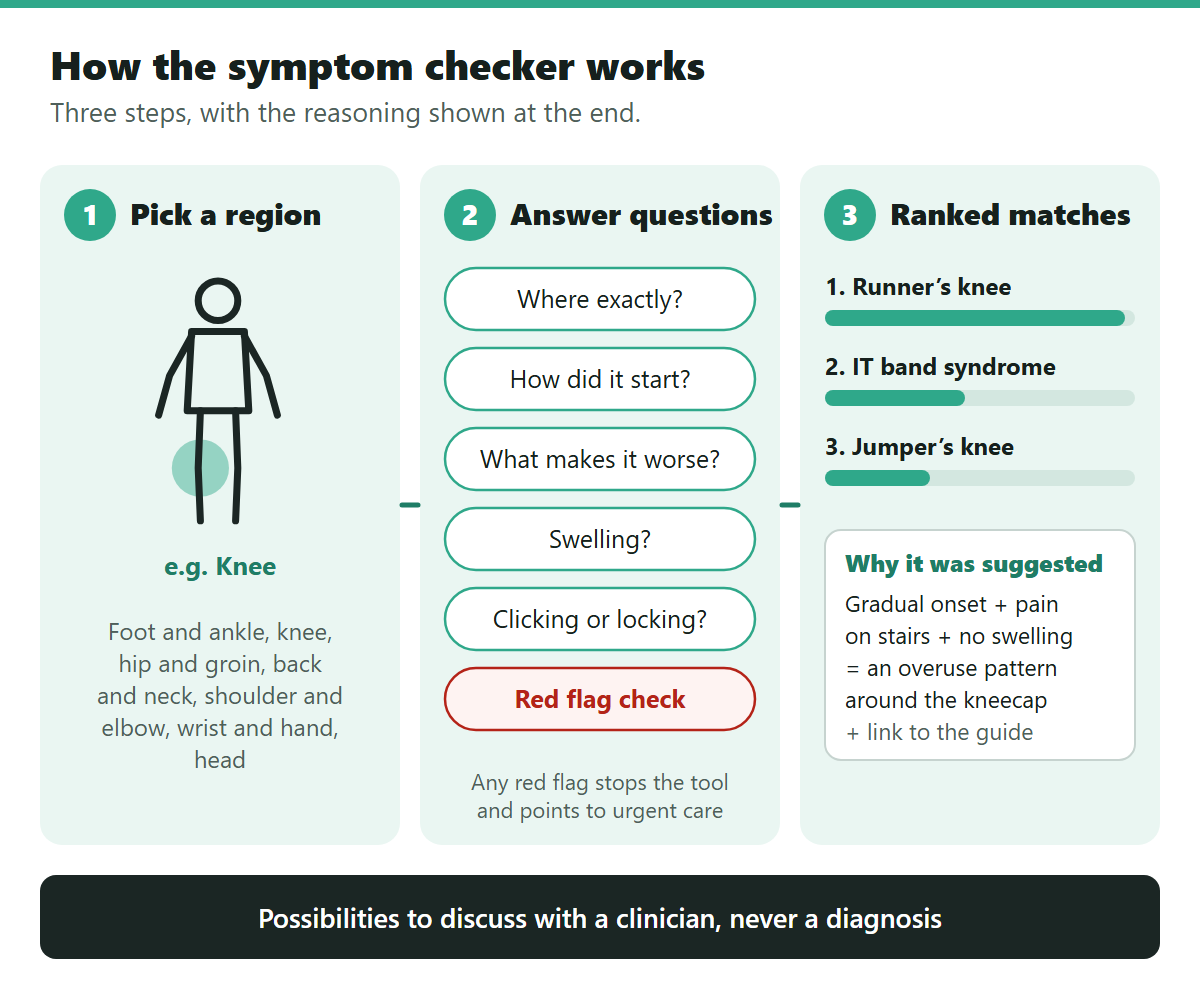
The checker works the same way a sports therapist starts a first conversation with a new client. First, we narrow it to a body region, because the knee and the ankle have completely different lists of usual suspects. Then we ask a handful of questions that genuinely change the picture: exactly where it hurts, how it started, what makes it worse, whether there is swelling, and one or two region-specific questions like clicking, locking or a pinpoint sore spot.
Each possible injury in the tool has a set of features that commonly go with it. A plantar fasciitis pattern, for example, usually involves pain under the heel, a gradual onset and pain on the first steps of the morning. When your answers line up with those features, that possibility scores higher. The tool then ranks the matches and tells you exactly which of your answers pushed each one up the list, so you can see the reasoning rather than just a label.
That last part matters. Many online symptom checkers simply hand you a list of conditions with no explanation, which leaves you guessing why. Here, every result comes with a plain sentence like “suggested because of the gradual onset and pain that is worse after rest, which fits an overuse pattern more than a sudden tear”. If one of those reasons does not sound like you, that is useful information too.
Finally, every path through the tool includes a safety question. If you answer yes to a red flag, the tool stops and points you to urgent care instead of showing matches.
Why A Self-Check Can Narrow Things Down But Can’t Diagnose You
A self-check is good at one thing: spotting patterns. If you tell it your pain came on gradually, sits under your heel and is worst first thing in the morning, it can quite reasonably suggest the conditions that usually behave like that. What it cannot do is examine you.
A lot of injuries share symptoms. A sore inner knee could be a ligament, a meniscus, a tendon or pain referred from the hip. A sharp pain down the leg might be a hamstring strain or an irritated nerve from the back. Telling these apart often relies on hands-on tests, like checking how stable a ligament is, how the pain responds to specific movements, where exactly it is tender, and how strong you are compared with the other side. Sometimes it also needs an X-ray or a scan, which no online tool can replace.
Symptoms can also be misleading in both directions. Some fairly minor problems hurt a lot, and some significant injuries, such as a small fracture or a partial tendon tear, can feel surprisingly manageable at first. That is why we would always rather you treat these results as a list of questions to ask, not answers to act on.
What Happens At A Proper Assessment After You’ve Used This Tool
If you book a rehabilitation consultation with Impact Sports Rehabilitation, bring your results along. They give us a useful head start. We will talk through exactly what happened, how it has behaved since, and what you need to get back to, whether that is running, football, the gym or the mats.
Then comes the part a self-check cannot do. We examine the area, test movement and strength, use specific clinical tests to separate the possibilities, and look for anything that does not fit. Most of the time that gives a clear working diagnosis on the day. If it does not, or if something needs imaging or a medical opinion, we will explain why and point you in the right direction.
From there you leave with a plan: what to do now, what to avoid, and how to progress, which might include rehab exercises alongside hands-on treatment such as sports massage where it helps. We are based in Eccles, close to Salford, Trafford and Manchester, and offer online consultations for anyone further afield.
Got a shortlist of possibilities and want a confirmed answer? Book a rehabilitation consultation with Impact Sports Rehabilitation in Eccles, or online if you are further away, and leave with a clear plan.
Frequently Asked Questions
Can an online sports injury symptom checker actually tell me what’s wrong?
Not on its own. A good symptom checker can narrow things down to a sensible shortlist and explain why, which helps you understand your options and ask better questions. It cannot examine you, test your strength or stability, or replace a scan, so a confirmed answer always needs a professional assessment.
The top result sounds scary. Should I be worried?
Try not to read the top result as your diagnosis. The ranking only reflects how well your answers match common patterns, and several conditions share the same symptoms. If you are worried, the best next step is a proper assessment, and if you have any red flag symptoms, go to A&E or call 999.
Why does it ask how the pain started?
Because it is one of the most useful clues there is. A sudden pain at a specific moment points more towards a strain, sprain or tear, while pain that builds gradually often suggests an overuse problem such as a tendon or training-load issue. That one answer changes which possibilities make sense.
None of the results match what I’m feeling. What now?
That happens, and it is genuinely useful to know. The tool covers common sports injury patterns, so anything less common, or pain coming from somewhere else, may not show up. If your pain is not settling or does not fit, it is worth getting it assessed in person.
Is it safe to train while I figure out what it is?
It depends on the injury, which is exactly why a self-check cannot answer it. As a general guide, avoid anything that causes sharp pain, swelling or a limp, and keep gentle movement that feels comfortable. If you are unsure, get it assessed before going back to full training.
What will Impact Sports Rehabilitation do differently from this tool?
At Impact Sports Rehabilitation we examine you properly, using hands-on tests, movement and strength checks to separate possibilities the tool cannot tell apart. You get a working diagnosis, an honest explanation and a recovery plan built around your sport, either in Eccles or through an online consultation.
This sports injury symptom checker from Impact Sports Rehabilitation is for general educational purposes only. It does not diagnose any condition and cannot replace a physical examination, imaging or professional medical advice. Results are possibilities to discuss with a qualified clinician, not a diagnosis or treatment recommendation. For any red flag symptoms, go to A&E or call 999.